Big Garden Birdwatch 2019

It’s that time of year again – the Big Garden Birdwatch. I think every year I write a similar post about that mixture of anticipation and frustration that this fantastic bit of Citizen Science brings. The usual feeling of “where have all my regular birds gone” followed by the joy a pair of blue tits bring when they appear in the nick of time to make the cut. The red kites last week were undoubtedly magnificent, but when you’ve been sitting freezing your proverbial off for an hour, the sight of a pair of blue tits can be just as rewarding.

I did our garden count on Sunday, an unfortunately blustery day, which I presume is what put a lot of our birds off; rather than just sheer wilfulness to avoid being counted. In the end I only recorded 27 birds of 7 species – way below our garden norm and less even than I can see just glancing out now.  But data is data, so I hope our paltry count will still be of use. So all I saw was:

  • 14 sparrows – there may actually have been double that but, they were in the bushes and impossible to count more for certain.
  • 2 collared doves
  • 1 wood pigeon
  • 2 magpies
  • 1 blackbird
  • 5 jackdaws
  • 2 blue tits

I did try to take photos of those that landed on the bird table, but our overgrown teasels were flapping about in the wind in my line of sight, so I only managed one of the jackdaws.

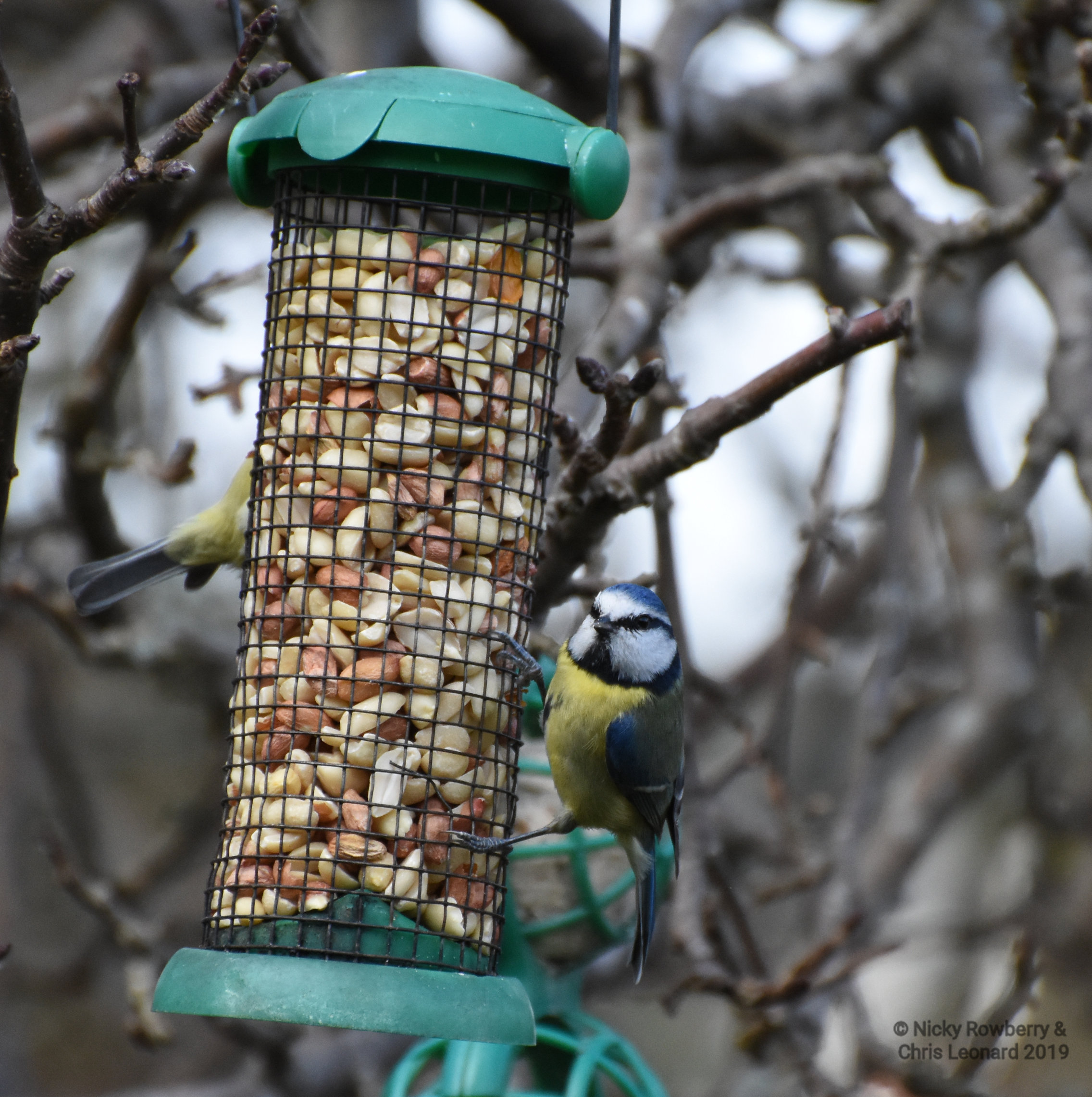
The blue tits were a bit easier as they were feeding in the apple tree closer to the house.

So that’s it over for another year. Apparently this year was the 40th anniversary of the Big Garden Birdwatch. It started as a survey just for children to do, but thankfully us adults are allowed to join in now too. Our garden birds often seem to make themselves scarce during this annual count, but it still gives me an enormous sense of satisfaction to know that we’re contributing to a really useful bit of science. And sitting just quietly watching the wildlife in your garden for an hour, with no interruptions or distractions is no bad thing either!


Barcud Coch & Cwm Elan – A Welsh Day Trip

Barcud Coch & Cwm Elan – well I hope I spelled them right (now I’m also worrying that I’ve spelled “spelled” wrong – should it have been spelt?) – or in English, red kites and the Elan Valley for a fantastic day out. We headed over to the Elan Valley first as several friends had recommended it as being well worth a visit. We somewhat underestimated how much was there and only had time to drive around about half of it, but the half we did see was amazing. The Elan & Claerwen valleys have been dammed in 6 places and the result is beautiful reservoirs set in even more beautiful countryside.

Our visit was on a bit of a dreary day weather-wise, but it had the advantage of giving everything a beautiful misty (bordering on foggy) atmosphere.
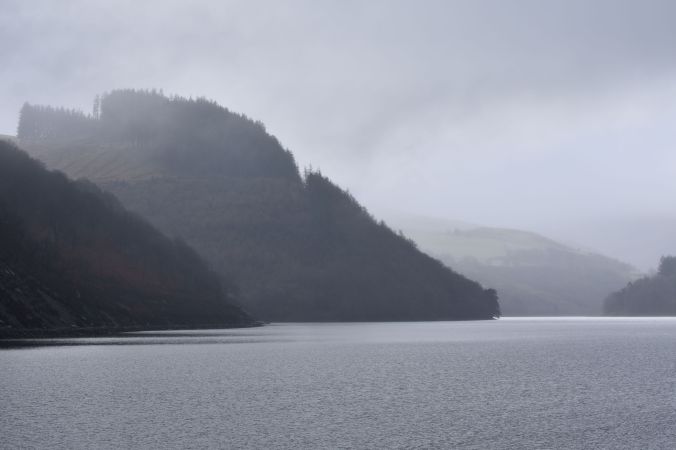
There was snow on some of the highest peaks, but nothing to hamper our exploration. In places the road was lined by avenues of tall trees, but elsewhere the views were pretty breath taking.

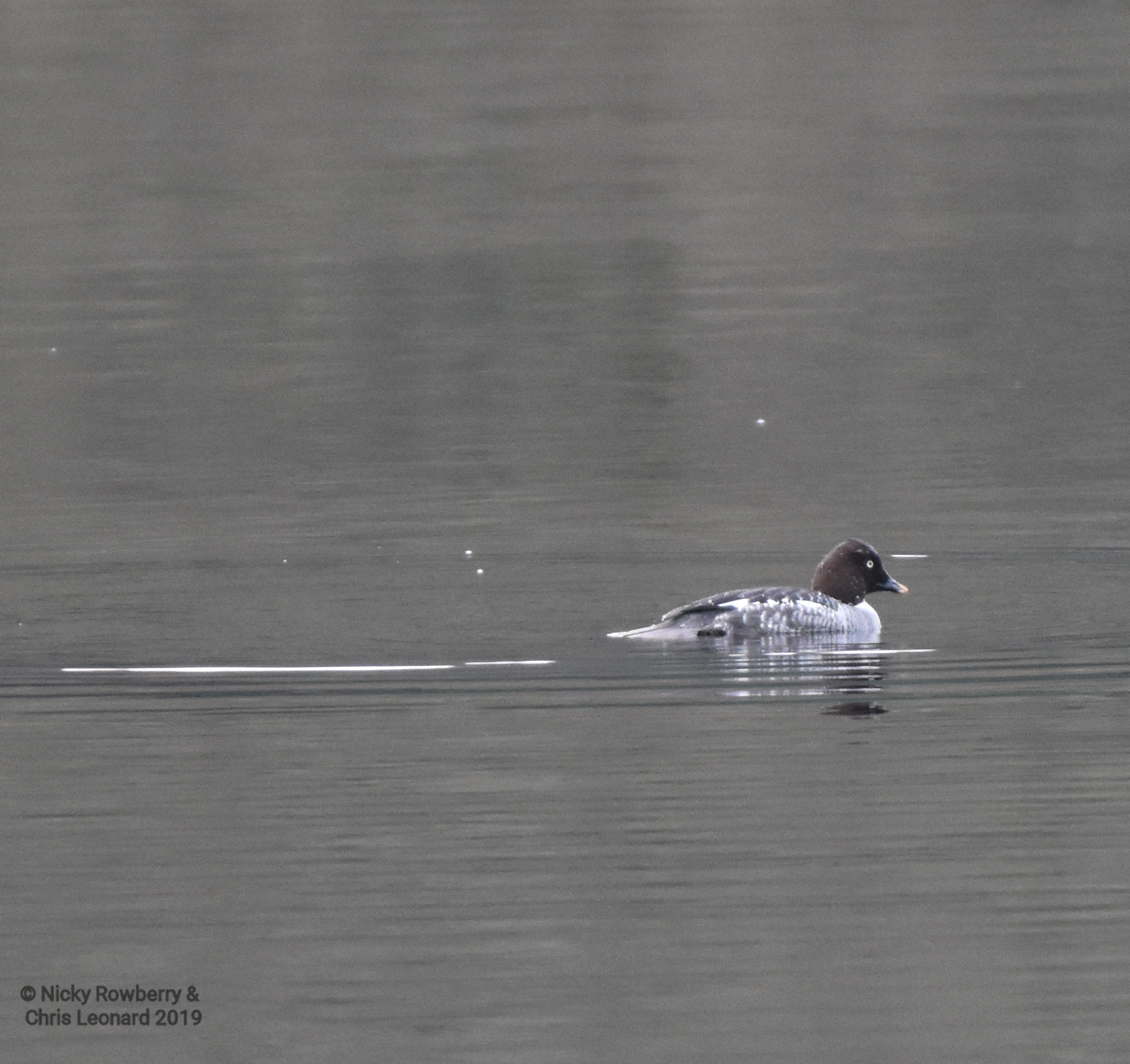
None of the dams were actually flowing on our visit, but hopefully next time we go back they might be. We found a well-kept (and surprisingly empty) bird hide, from which we could just about make out some ducks in the distance – too far away to get decent photos, but just close enough to identify them as a male (bottom) and female (top) goldeneye.

After the dams, we headed back through the small town of Rhayader to go to the Red Kite Feeding Station at Gigrin Farm. We’d pre-booked spaces in their photographic hide and had to be there by 2pm for the feeding. Gigrin Farm have been feeding red kites since the early 1990s. Having started with just a few pairs, they now regularly have over 300 red kites coming to the feeding station. So we were expecting a lot of kites, but have honestly never seen anything quite like it.

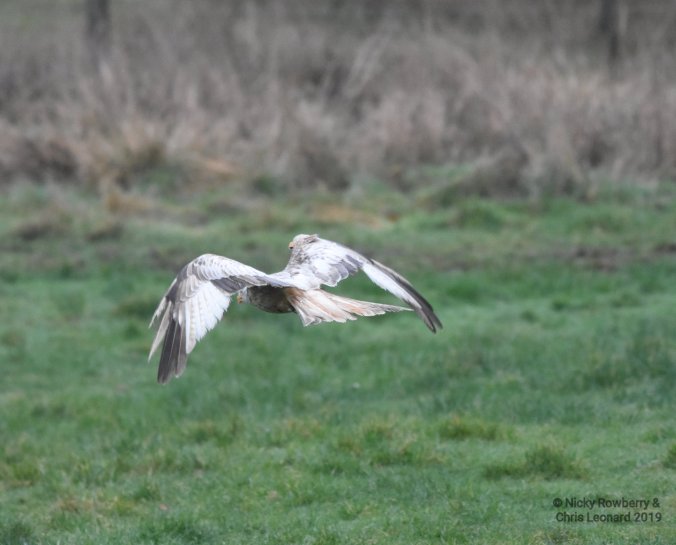
As we approached the hides, we spotted a huge white bird in the distance across the field.  Turned out it was a leucistic red kite; leucistic birds are not the same as albinos as they still have pigment in their eyes. Apparently up to 1% of the Welsh red kites are actually white or partially white.

As 2pm drew closer we could see more birds amassing in the surrounding trees. They clearly all knew what time the food was due.

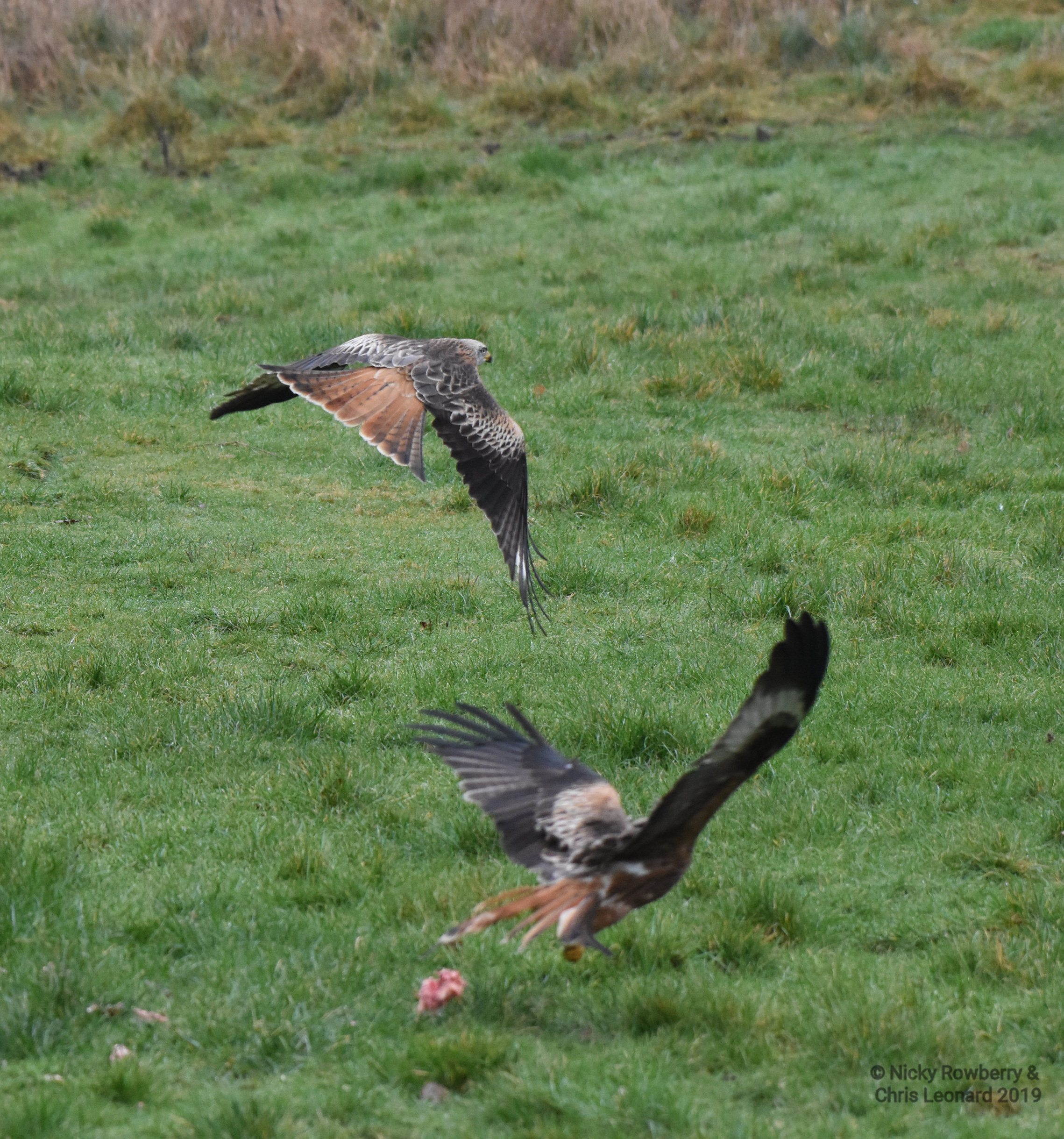
2pm on the dot and a tractor appeared to dish out the meat for the birds. Within seconds the sky was full of swirling kites – literally hundreds of them.

I then tried to film them as they swooped down to pick up the meat. They are so fast it looks as if the film has been speeded up, which it hasn’t.

Initially we thought this was great and we were going to get loads of amazing photos as they were all so close. Then we discovered the problem – there were so many and they moved so fast, it was impossible to focus on just one and get a nice sharp photo. We can now understand why small birds flock together in large numbers to confuse predators; this massive flock of kites had the same effect confusing us photographers. So although we took over 750 photos between us, I don’t think a single one is as crisp and clear as we would have liked. In our defence we weren’t helped by the dull overcast weather and it may have been better on a sunny day.

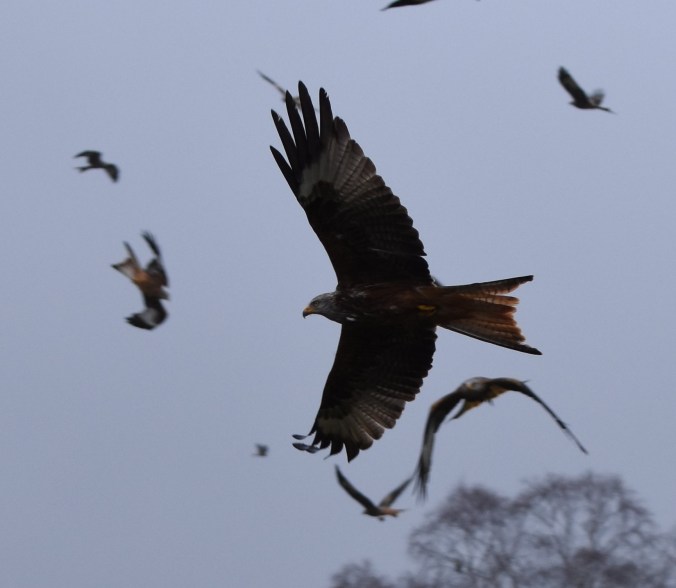
Having said all of that, it was still an absolutely stunning spectacle. Once we stopped worrying about the photos and just stood back and watched, it was just incredible. We have seen red kites before of course, but never so close up. I hadn’t realised how huge they are; their wingspan is pushing 2 metres!
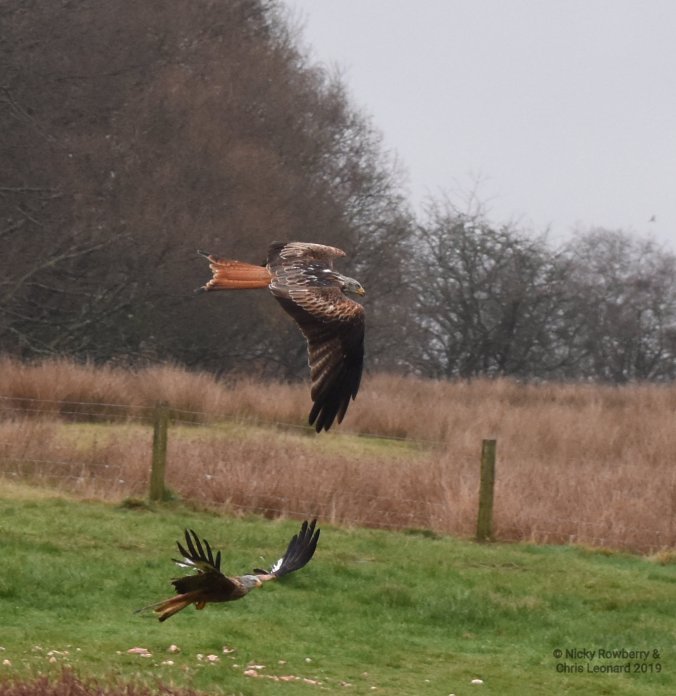
The numbers swooping down at any one time were incredible.

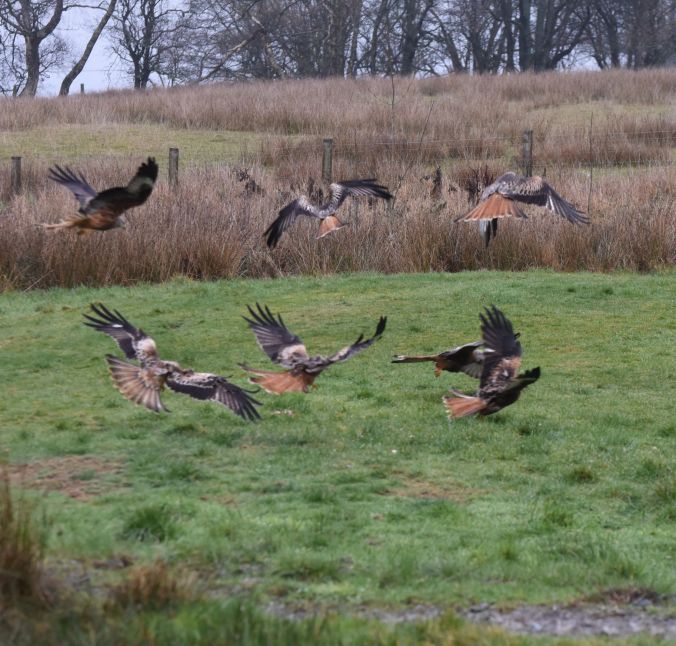
This next photo looks like it is a composite shot of 4 birds, but is actually 4 in a row, all swooping down and off again one after another.

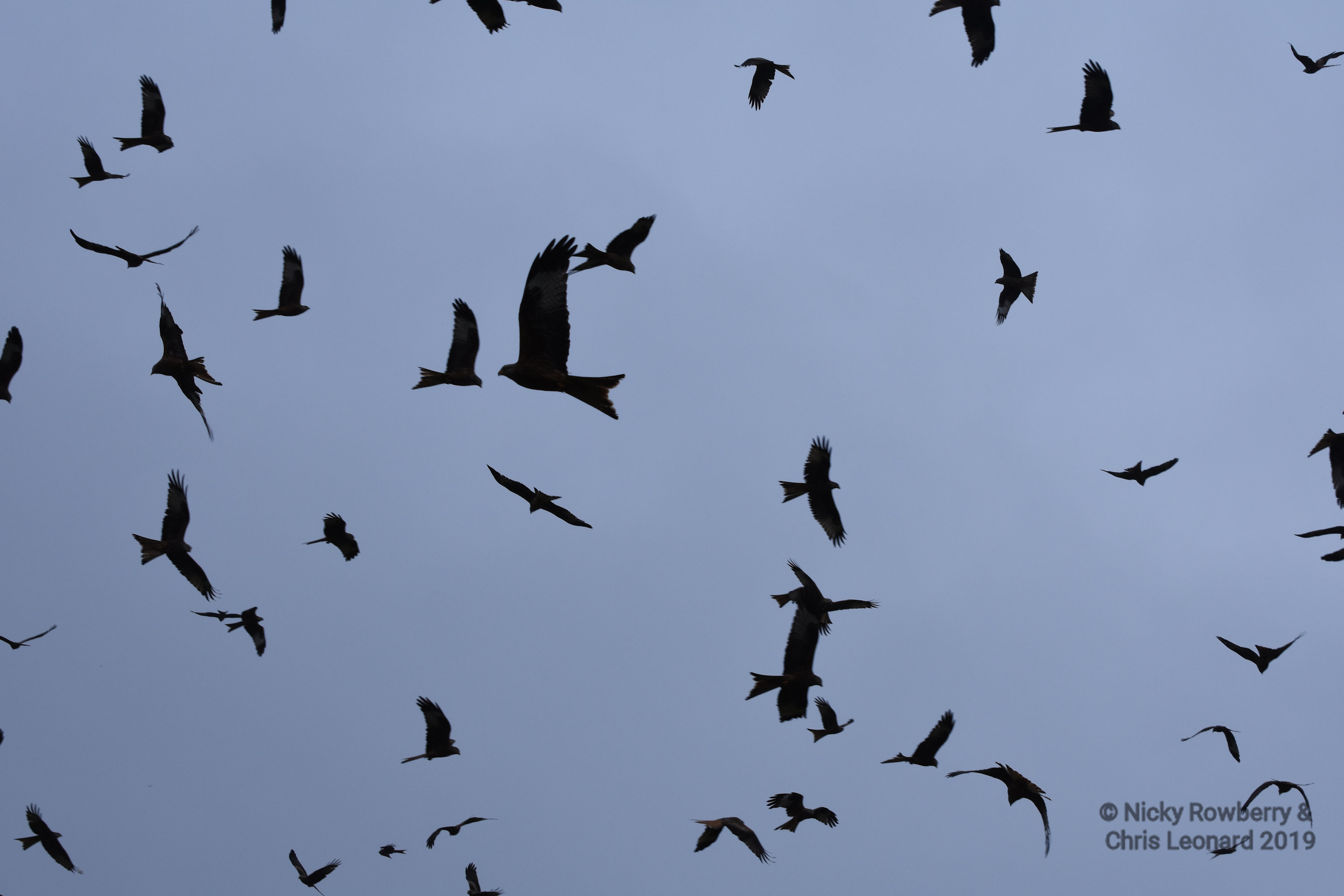
When viewed in the sky they almost formed an abstract pattern silhouetted against the sky, wings pointing in every conceivable direction.

Their aerial acrobatics were phenomenal, twisting and turning as they dived. They’d scoop up a piece of meat in their talons, then bend over to transfer the prize to their mouths to eat.

Here are a few more photos of them for no other reason other than they are really photogenic birds.

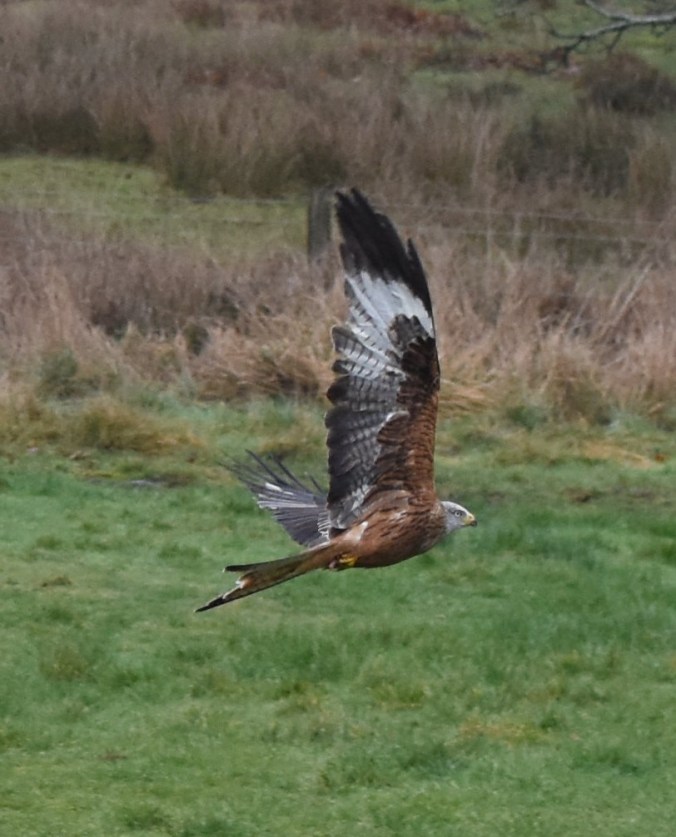
The white kite that we’d seen as we arrived put in several appearances, easy to spot amongst the more usual coloured ones. He/she appeared to have a number tag on his wing, so may be part of some study.
Red kites of course weren’t the only birds of prey making the most of the meaty picnic. We saw several buzzards watching from the trees. Perhaps because they are slightly smaller than the red kites, they are content to wait their turn.

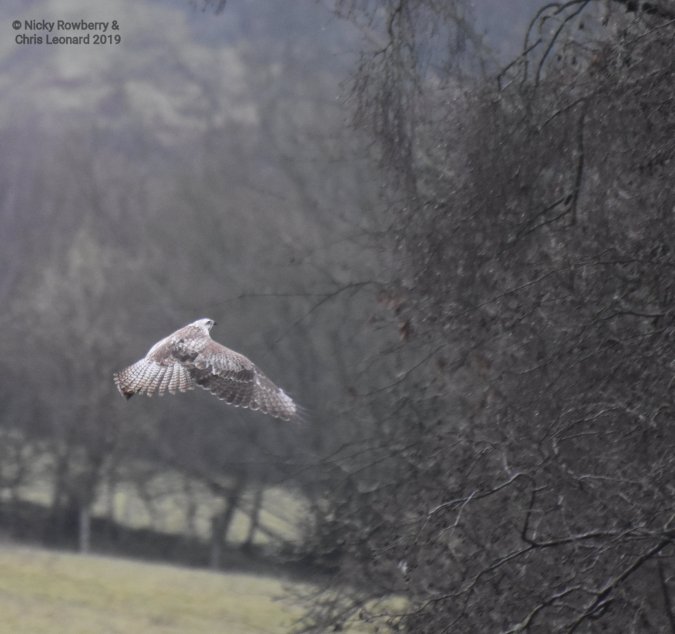
We didn’t see any come down while we were there (although to be honest there may have been some amongst the melee of red kites), but we did see this one glide beautifully into the tree, displaying its gorgeous fan shaped tail.
And of course there were large members of the crow family making the most of the opportunity too. Initially we thought they were all carrion crows, but I think there were a few rooks lurking in there too – distinguishable by their paler beaks and pointier looking heads.

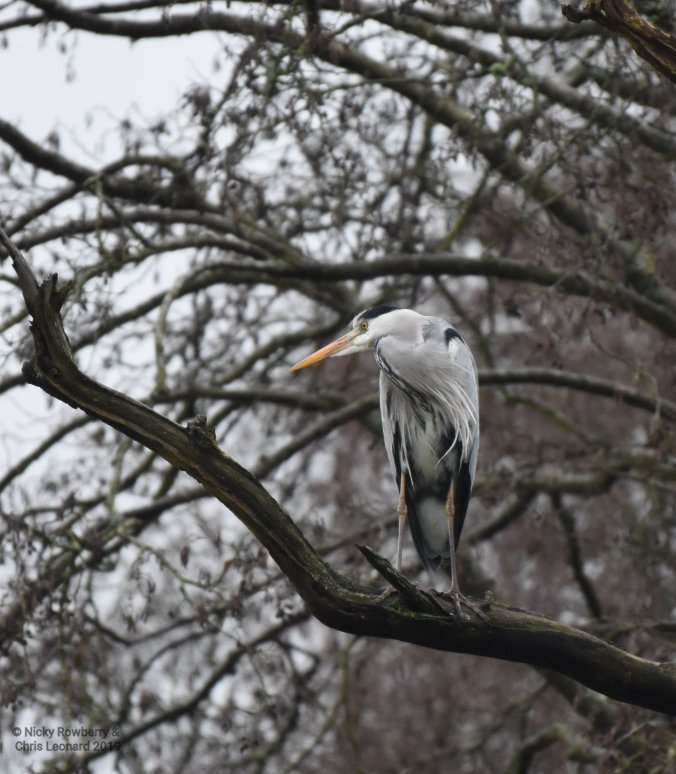
Final treat of the day – a heron flew lazily (in comparison to the kites at least) across the field and landed in a tree.
Hopefully we can go back to see the kites again in the summer when the light should be better and we can perhaps get crisper photos. But in the meantime we’ve got the memories of one of the most amazing wildlife spectacles we’ve ever seen.

Birdy Benefits of the Beast from the East

Well if February was freezing, March so far has been all about the snow. The so called Beast from the East weather front certainly dumped a whole lot of snow on us in Malvern. I couldn’t get to work on Thursday or Friday due to the drifting snow, so have spent much of the last few days birdwatching in the garden. The upside of all this snow is that it has brought lots of birds in from the fields looking for food. In particular, the Beast from the East has brought us fieldfares and redwings – lots of them!

But first surprise was to find a very large gull on the bird table. We see them flying overhead quite a bit, but this was the first time I’d seen one actually land in the garden. I’ve nothing against gulls, but I don’t think I can afford the seed bill if they start regularly hoovering up the bird food!

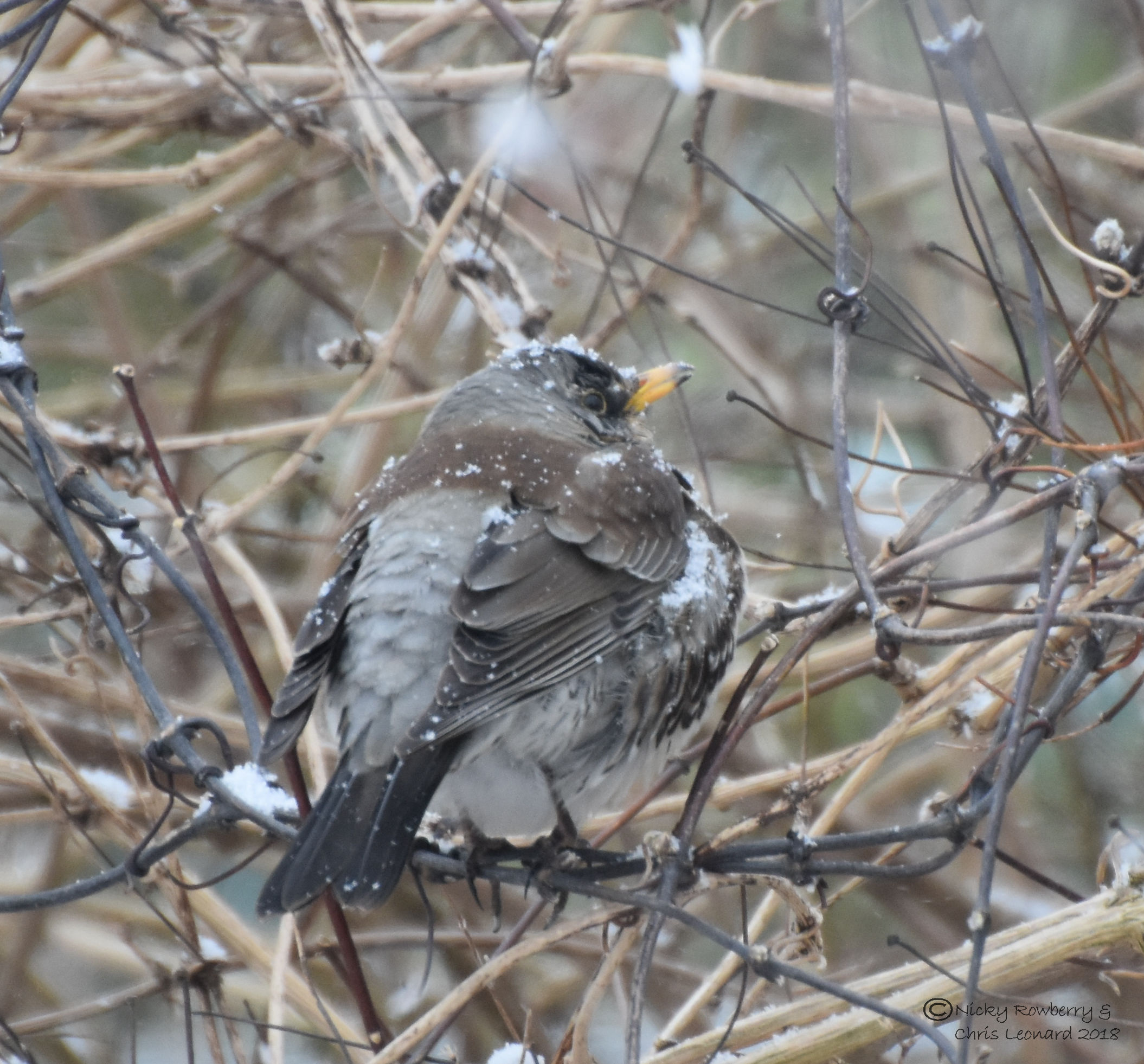
When the snow arrived at the end of last week, I was hopeful we might get a fieldfare or two, but there was a whole flock of them. Of course being wilful, they seemed to sense that I was the one on the street desperate for a photo, so stayed mainly just out of photo range in the neighbours’ gardens. But eventually a couple graciously honoured our garden. This first one looked distinctly unimpressed by the weather though and sat hunched in the bush with snow settling on him.

He did however discover some berries we’d got left so I could get a few more attractive photos, although unfortunately these had to be taken through our grubby windows so aren’t as sharp as I would have liked, but better than nothing.

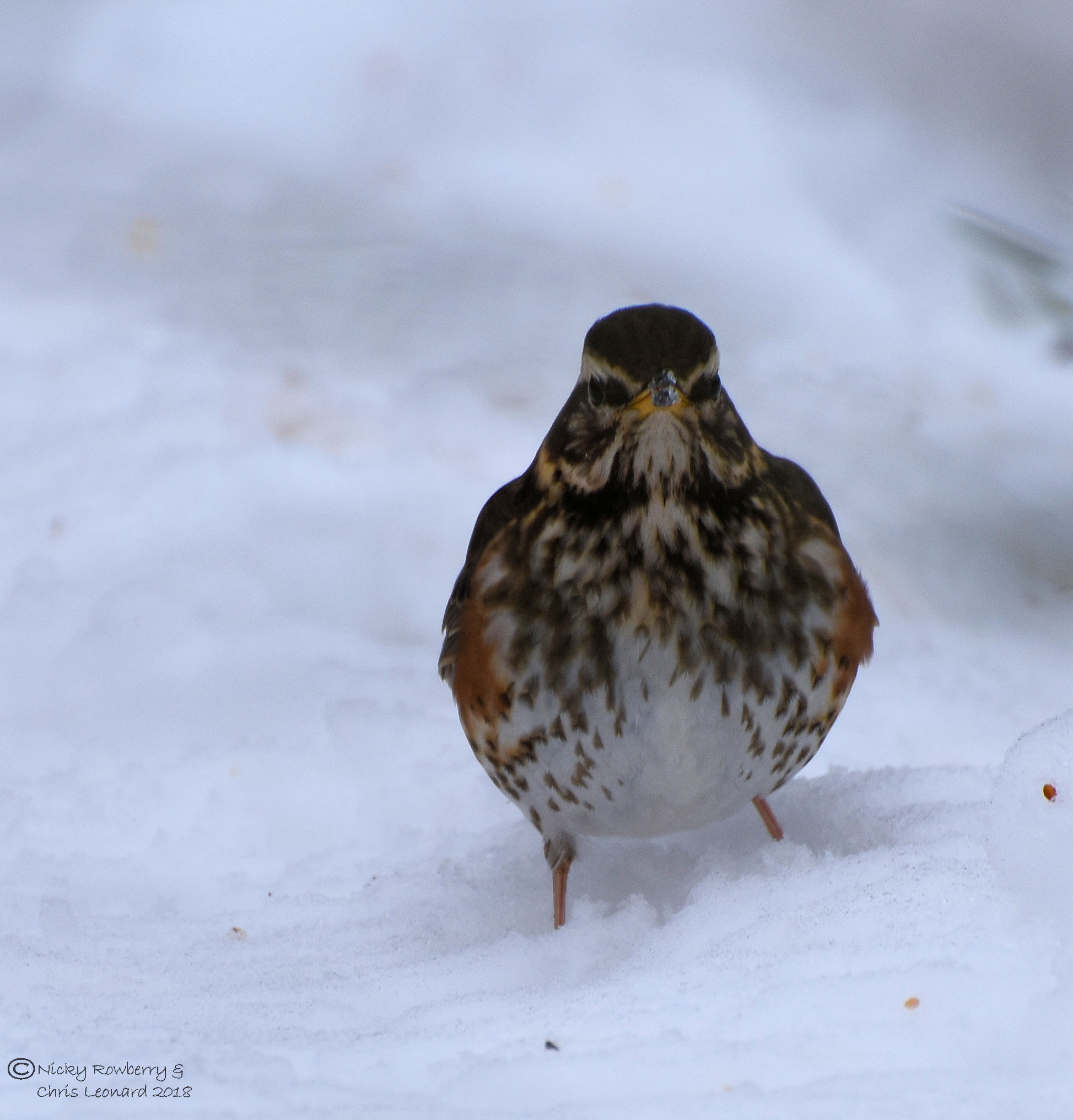
Having bagged a few fieldfare photos, I then started to wish there were some redwings around as well. Right on cue a small flock of these turned up too. (Maybe I should have wished for a Golden Eagle or a hummingbird?) Again it took me a few attempts stalking around the garden to get a half decent shot, but persistence paid off in the end.

Not to be outshone by his bigger and showier cousins, our resident song thrush was a frequent visitor this weekend too. Counting the blackbirds too, that’s 4 members of the thrush family in one weekend. Not bad.

I would have been quite happy with all of the above, but the goldfinches decided finally that they would like to spend some quality time in our garden. There were 4 in total, although I never managed to get more than 2 in one shot. Absolutely beautiful birds, I’ve always loved goldfinches.

I read on Twitter that goldcrests sometimes come into gardens when it’s snowy and again much to my amazement one appeared in the buddleia bush. Only the second time we’ve seen one on our garden. Sadly I was too slow to get a shot of it, he was just too quick.

So March has come in like a lion, let’s hope it goes out like a lamb. All this snow and birdlife has been lovely, but I’m starting to long for butterflies and bees and moths – roll on spring!

Freezing February Birds

It’s February and it’s freezing and being a bit of a fair weather nature watcher I’ve not been out much – other than to constantly top up the bird feeders and defrost the bird baths of course! So it’s been a month mainly of bird watching through the window or via the cameras in the garden. Our array of camera gadgets is slowly growing. Trouble is with each one you get, you tend to want more; or at least that’s how it seems in our house. No matter where we’ve got cameras pointed, there always seems to be something more interesting happening elsewhere in the garden!

Anyway like much of the country we’ve had snow yesterday and today – not a huge amount, but it’s never really got above freezing here.  So it was a nice surprise to download the trail cam in the afternoon and find a pair of goldfinches had visited our new niger seed feeder. Sorry the video is a bit dark, but it was snowing!

Inspired by our intrepid goldfinches, I got round to sorting through some videos we’d taken in the garden in the last week or so, to see what else I could find.

We’ve got a new GoPro camera which can be remotely activated using a phone. Perfect on a cold day for sitting on the sofa hitting record whenever something interesting appears. I’ve been trying out different angles and distances to see what works best. This video was shot with the camera only about a foot away from the action.

This next video compilation was the GoPro again, but this time filmed from a greater distance looking down. The greater distance does of course give a wider field of view and I think  the GoPro lens may be a wide-angle one too. You can still see lumps of ice in the bird bath although I had already taken two kettle loads of warm water out to defrost it.  Lots of different species of birds have been using the bird bath in this cold weather though, so it’s well worth thawing it out.

This next little compilation was filmed with the GoPro strapped to a branch next to some of the feeders. The GoPro has the advantage here over the old trail camera in that it is much smaller, making it easier to position closer to things. You can strap it to twigs that would be too thin to support the trail cam.

But I have not abandoned my old faithful Bushnell trail cam. I had it pointed at the same feeders, but from a different angle. I was really chuffed that it filmed a couple of the siskins that we’d been so excited to see the previous week. It also picked  up the female blackcap, although the male still eludes us. It was nice too, that between the two cameras, there was footage of 3 of the 4 species of tit we get in our garden – blue, great and coal. The long tailed tits as usual refused to perform for either camera.

One final surprise the cameras threw up was a visit from our squirrel – trying (but failing) to get into the peanut feeder.  I suspect he managed to get some of the other food out of shot.

Most of our regular bird species show up on one or other of the remote cameras but not all. So sometimes I just need to get off the sofa and sit in the garden with a “proper” camera. These jackdaws are regular visitors to the bird table and are particularly keen on the suet pellets. It does look slightly oddly like the one on the right is taking suet to the table rather than taking it away?

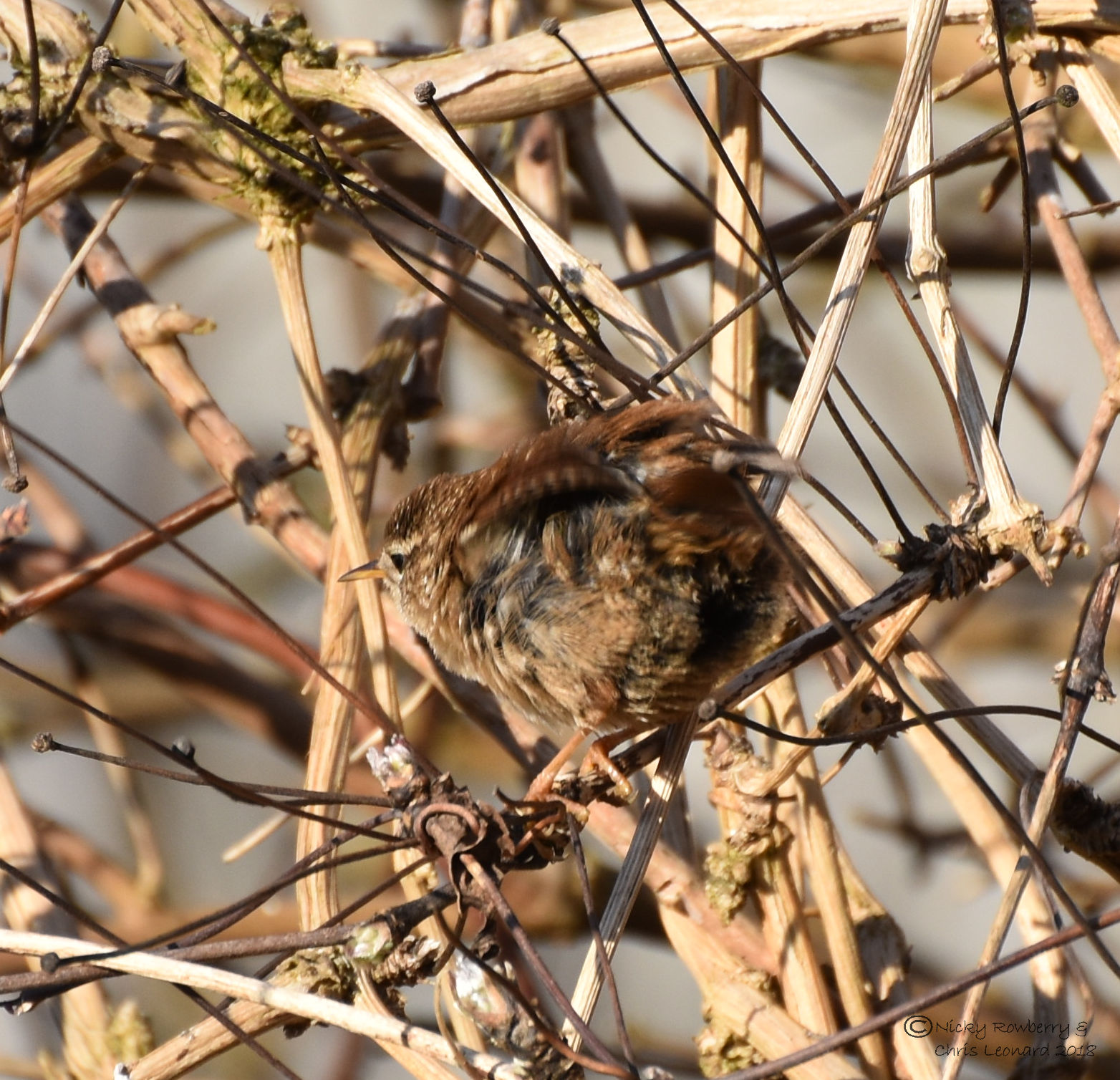
The wren of course seldom deigns to feature on the trail cam/GoPro videos. But this week he/she was more obliging than usual and did allow me to get a few shots. None perfect, but recognisable at least.

It even sat for a while preening itself, hence the next sequence of three “rumpled” looking photos.

So although it’s bloomin’ freezing, there’s plenty to watch in the garden. The bird feeders are busier than ever, so hopefully our garden birds will make it through this cold spell.


Big Garden Birdwatch 2018

Last weekend was the annual Big Garden Birdwatch – one of my favourite bits of citizen science to participate in. Unfortunately it was one of those dull, grey January days where the sun just doesn’t come out – and nor did many of the birds. Coupled with that, my camera was in for repairs so I couldn’t even take photos of the ones that did appear. I persevered though as it would have been a shame to miss out on it this year, having done it for the last few years.

So I spent an hour crouched behind my camouflage netting hoping neither the birds nor the neighbours could see me (neighbours think we’re mad enough as it is without seeing the camouflage!). As always seems to be the case, the birds which moments before had seemed so plentiful, all disappeared as soon as I got my notepad out. But my masterplan worked as I’d topped up all the bird feeders just before and they couldn’t resist indefinitely.

The sparrows were abundant as usual. I’ve no idea how many we really have visiting the garden, but I’m sure it’s much more than the 13 I managed to count in one go. I suspect we have closer to 25 or even 30, but they’re impossible to count all together, so I stuck with the 13 definite that I could see at once.  Next largest presence was the jackdaws – 5 of whom put in an appearance on the bird table. These are at least big enough and obvious enough to be much easier to count.

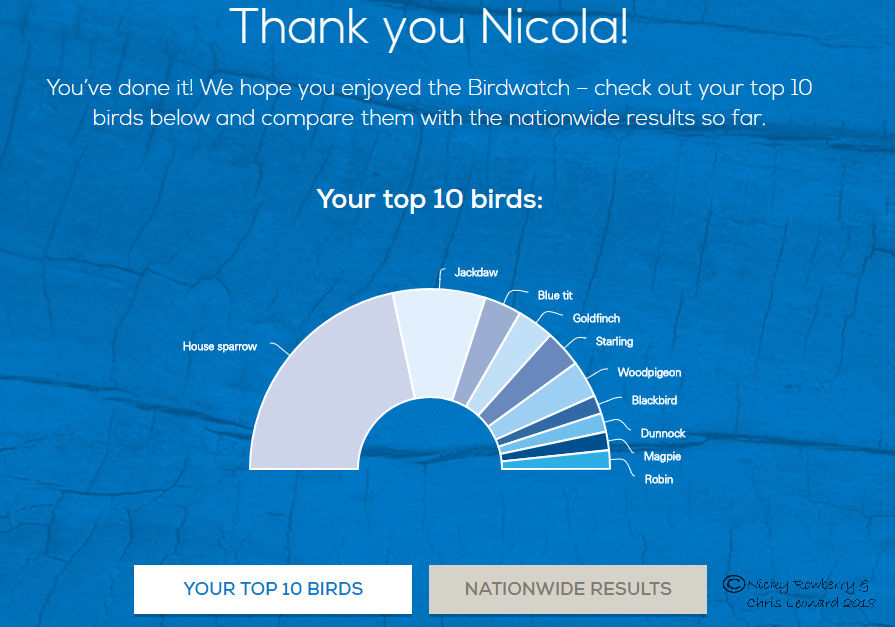
The rest of the birds came in just ones and twos: blue tits, robin, blackbird, goldfinches, starlings, woodpigeons, crow, dunnock, blackcap (female) and magpie. A total of 32 birds of 12 species. As usual I had several no shows – birds that have graced our garden in the days before and days after the count. These include the wren, great tits, coal tits, long-tailed tits and chaffinch – all of whom I’ve seen today.

The RSPB give you a nice little pie chart when you upload your results. It only shows 10 species, so misses out the crow and the blackcap, but at least represents 30 out of the 32 birds I saw.

You can also get a similar representation of the national results so far. So as of this afternoon, sparrows were leading the way nationally, as they were in our garden. But there was no sign of our second most abundant bird, the jackdaw, in the nation’s top 10. Perhaps we are just in a hotspot for jackdaws, or they particularly like the selection of bird food we put out here?

This year’s results for our garden were very similar to last year’s (https://toolazytoweed.uk/2017/01/28/big-garden-birdwatch-2017/). So it’s good to know there are no dreadful declines here at least – keep putting out the bird food and they will come!

So a bit of birdy citizen science – a weekend well spent I reckon.

The Adventures of Tiny Tim the Hedgehog

I’ve been meaning to do an update on our garden hedgehogs for a while now, so today is finally the day. Although we haven’t seen a hedgehog in the garden since December 17th, we now have a resident foster hog – here’s his story. In my last hedgehoggy blog post, way back at the end of October, I mentioned that we had a large and a small hedgehog visiting the garden.

The two often appeared together, although they tended to arrive separately. The little one (Tiny Tim) generally seemed quite interested in the bigger one (Fat Sam as I’ve been calling him), but Fat Sam didn’t seem quite so impressed!

They would sometimes even go into the feeding station together. On one occasion the Tiny Tim got trapped in there for a few minutes when Fat Sam decided to plonk himself down just outside the entrance – effectively blocking the Tim in. The video below is a compilation of several short trail cam clips taken over a few minutes while he was trapped! Eventually Sam got bored and wandered off, freeing the youngster.

Although it was great to see the two together, I was worried  that Tiny Tim might not be big enough to get through the winter. The only way to be sure was to catch him and weigh him – hedgehogs need to be an absolute minimum of 450g to have enough fat reserves for hibernation.

Unfortunately our diminutive visitor didn’t come at a regular time, so the only way to catch him or her was to sit out and wait. After a couple of fruitless nights (my commitment to sitting outside in the dark didn’t extend beyond a few hours at a time) and a few false alarms (Fat Sam got himself weighed too – a very respectable 800g), I eventually got lucky at the beginning of November.  Fortunately he turned up at the feeding station at about 8:30pm and was no doubt a bit surprised to find me lurking nearby with a set of kitchen scales. The little guy only weighed about 400g so wouldn’t have made it through the winter without some help. So into the cat basket he went and along to Viv at Malvern Hedgehog Rescue.

Viv checked him over and found he had a cough, so he was treated for lungworm; a potentially fatal condition, so another good reason to rescue him besides his size. Viv was also able to confirm Tim was indeed a he!

A couple of months later and Tiny Tim is not so tiny any more – a very healthy 1100g, plenty big enough to survive hibernation now. So he’s come back to our garden to stay in the hutch until the Spring. I’ve not taken a photo of him, as I wanted to let him settle in and don’t want to disturb him any more than I have to. I will try and get the trail cam pointed at the hutch, to see if I can get any footage of him moving around at night. Hopefully though he’ll settle down and hibernate, but if not he’s got a des-res with food and water until it’s time to let him go. Many thanks to Viv (http://www.malvernhedgehogrescue.co.uk/) for getting him through the winter.

Tiny Tim may have spent most of the winter in the lap of luxury, but Fat Sam had to take his chances in our neighbourhood gardens. Fortunately  several of the neighbours like hedgehogs too and don’t mind having gaps in their fences so that the hogs can roam freely between the gardens at night. This footage shows Fat Sam squeezing himself under our fence and into next door’s garden.

We’ve put a couple of hedgehog houses out in the garden in hope of tempting Fat Sam to hibernate. I got my hopes up for a few days when the trail cam spotted him checking out one of the houses,

Unfortunately it didn’t impress him enough for him to make a nest in it. Hopefully he found somewhere more to his liking elsewhere in our garden or in one of the neighbours’ gardens. There are certainly plenty of wild untidy bits in ours that would hopefully make good nesting sites.

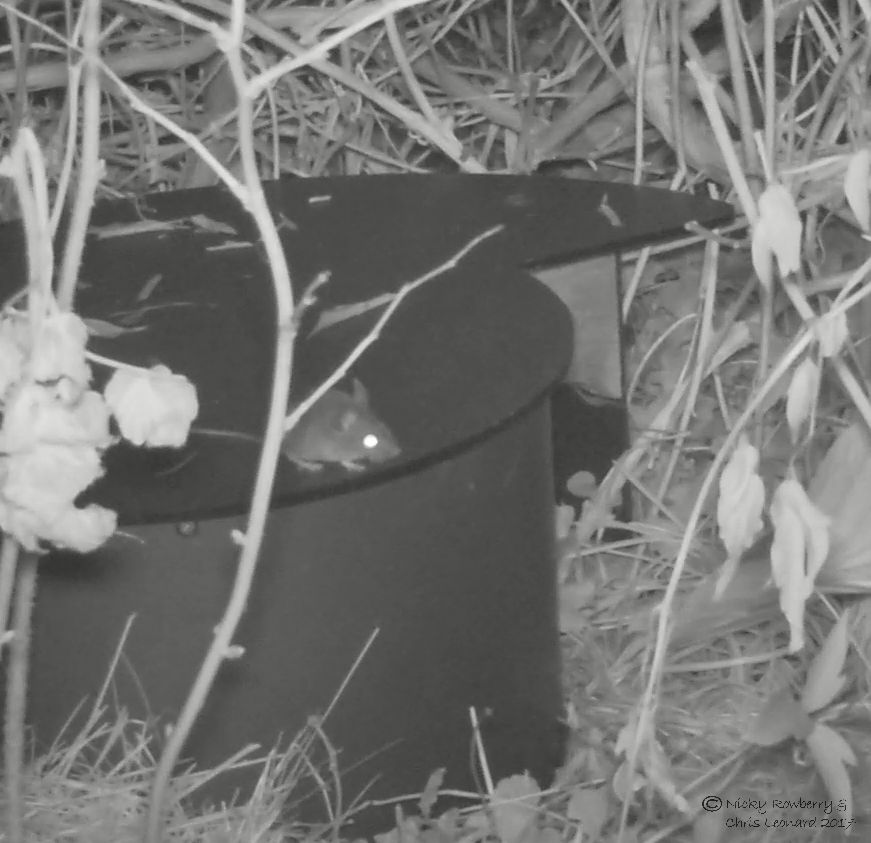
Fat Sam may not have made it his home, but the hedgehog house did attract some other visitors. This mouse appeared several times, clambering up the old clematis stems to sit on the box.

And this large fluffy cat (one of the neighbours’ not ours) also seemed to like sitting on top – perhaps knowing there were mice nearby?

Hopefully I’ll be able to post some videos of Tim in his hutch at night, but failing that I’ll post an update on Tiny Tim and Fat Sam in the spring when they come out of hibernation. Fingers crossed for a successful hibernation for hedgehogs everywhere.


Birding in Bewdley

Since the New Year I’ve been suffering (rather pathetically even by my own low standards) from the flu, but by last Sunday I’d finally had enough of my sick bed and was keen to get out and see some wildlife. While spluttering round the house, I’d kept seeing on Twitter that there were lots of Hawfinches in the UK this year and that in particular there was a group of them in Bewdley, which isn’t far from us. People were still tweeting sightings of the Bewdley birds there on the Saturday so we set off on Sunday with fingers crossed.

Bewdley is a lovely little town, right by the river Severn. We’ve passed through it a few times on the way to the Wyre Forest, but never stopped before. So this time we parked down by the river and set off to find Jubilee Gardens where all the Hawfinches were apparently hanging around waiting for their photos to be taken. Since there’s never any guarantee of spotting your target species, we always take photos of other things as we go and the Severn was full of birds as we walked along the towpath.

There were quite a few of these small pretty gulls, several of whom seemed content to perch on the bollards. A quick check on Google when we got home later confirmed they were Black Headed Gulls – in their winter plumage though, so no actual “black heads”.

Another bird that we more commonly associate with the sea is the Cormorant, but there was at least one happily paddling up and down the Severn in Bewdley. It was totally undeterred by the Canada Geese that not only outnumbered him, but were much larger too. The Cormorant faced down at least one goose to get the resting spot he wanted near the steps.

We found Jubilee Gardens tucked away behind the riverfront houses. It is really a small park completely surrounded by the town of Bewdley, but with some large mature trees and a small pond.  There were plenty of small birds flitting around, including a small flock of the lovely long-tailed tits.

A splendid Grey Wagtail was patrolling, with tail wagging, up and down near the pond. I always have to think twice about these, not to call them Yellow Wagtails, despite their obvious yellow colouring.

We knew we’d found the right spot though, when we turned a corner and were confronted with at least a dozen birders with cameras/binoculars/telescopes all pointed up at some of the tall trees. Clearly I’m not the only one who follows the reports on Twitter! There were also a few other, slightly bemused looking, non birders trying to enjoy a Sunday stroll through the gardens and wondering what all the fuss was about.

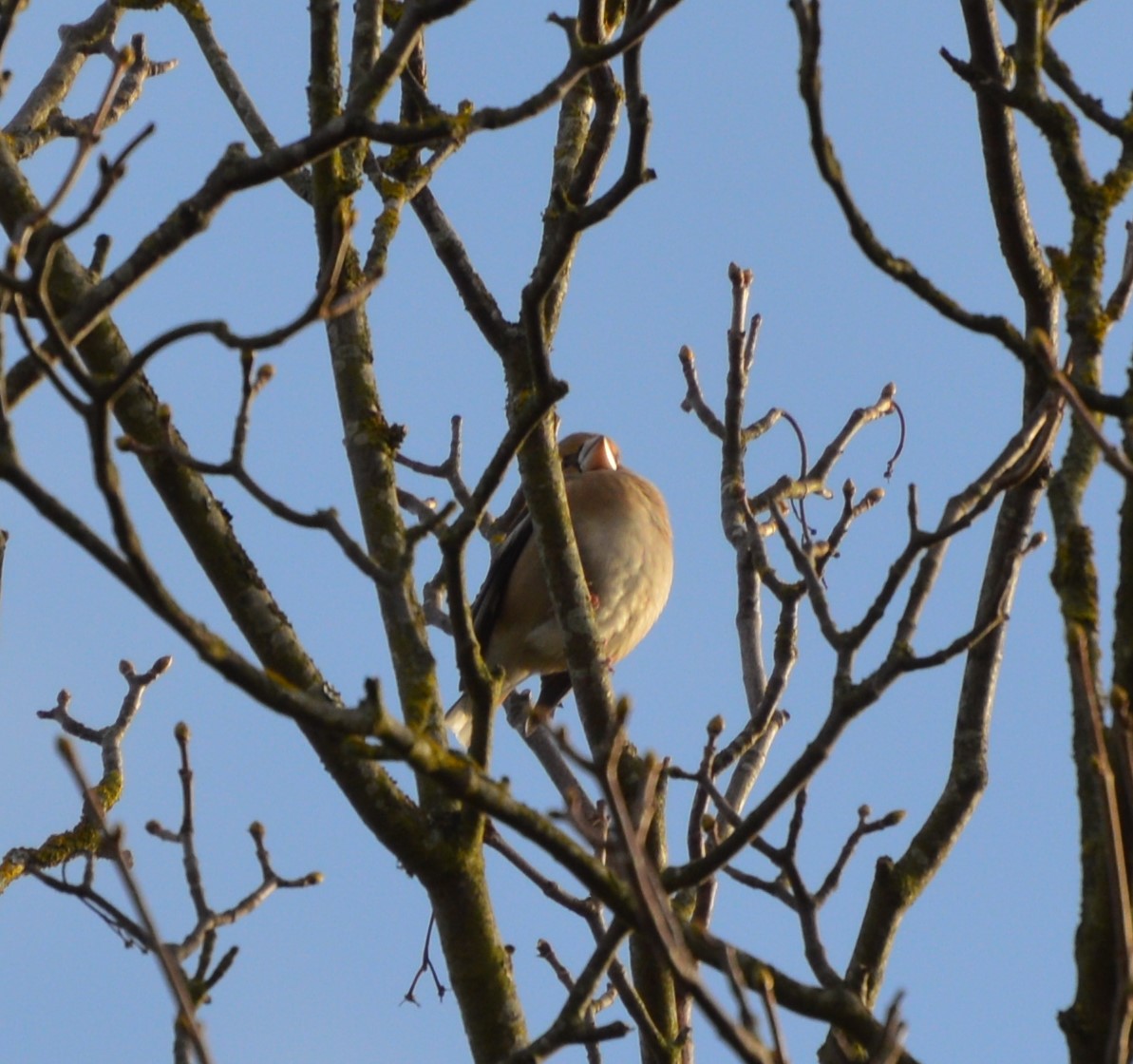
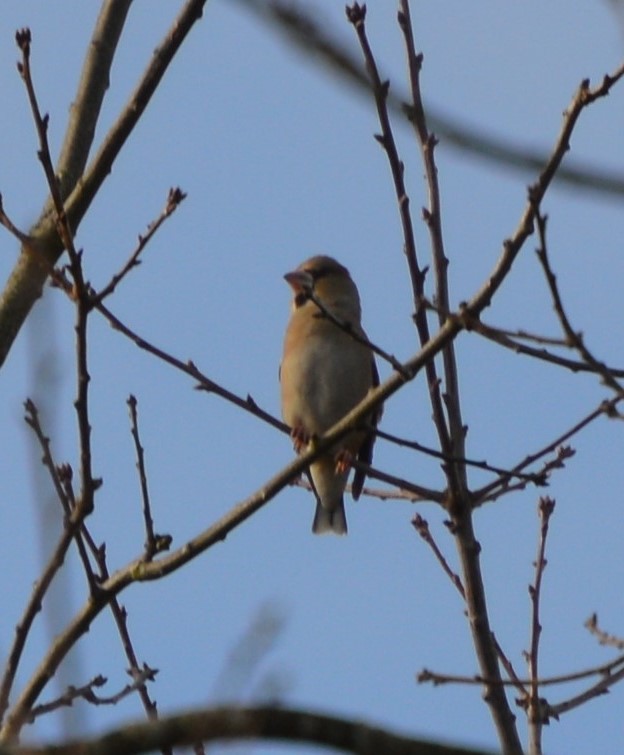
Anyway we followed the direction all the lenses were pointed in and sure enough there were a small group of Hawfinches, high up in the trees. They may have been distant glimpses, but we had found our first ever Hawfinches. Their powerful beaks were clearly visible even from a distance and they are have to my mind quite quirky, curious faces. We spent about an hour pottering round the gardens, hoping they’d come lower down. Not surprisingly, given the large number of people staring at them, they chose to remain high up in the trees. I didn’t really have a long enough lens to get anything even half decent. So these were the best shots I managed – just about recognisable as Hawfinches, if you sort of squint and use your imagination!

I don’t think I’d ever have spotted them on my own, but the combination of helpful Twitter feeds (thank you @WorcsBirding) and of course a large flock of Twitchers made it possible. We just need the equivalent combination for some Waxwings now!

From Green to White

What a difference a day makes. Since my Evergreen blog post our Malvern landscape has been transformed into a frosty white wonderland. It snowed all day on Sunday – the most snow we’ve had in years here and temperatures have barely got above zero. For the first day we couldn’t even see the Malvern Hills – the snow and fog completely blanketed them. But yesterday it cleared and our view was once again returned.

Our mistletoe, that was making me feel so festive, is now even more Christmassy with a frosting of snow.

I may not have been able to get to work, nor get the car out to go to the shops (chocolate supplies are getting dangerously low and I may have to start eating some wrapped Xmas presents!), but it has provided some great photo ops in the garden. I have spent a lot of the last few days freezing my proverbial off, sitting in the garden watching the birds. The bird feeders have needed constant topping up and the water baths have had to be defrosted regularly, but I have been rewarded with lots of bird activity.

As always I had the trail cam out in the garden. Although I didn’t get any particularly interesting footage during the day, that may have been because things were landing on it rather than in front of it!

Similarly my camouflage netting, that I hide behind to photograph the birds, got the same lack of respect from this blue tit.

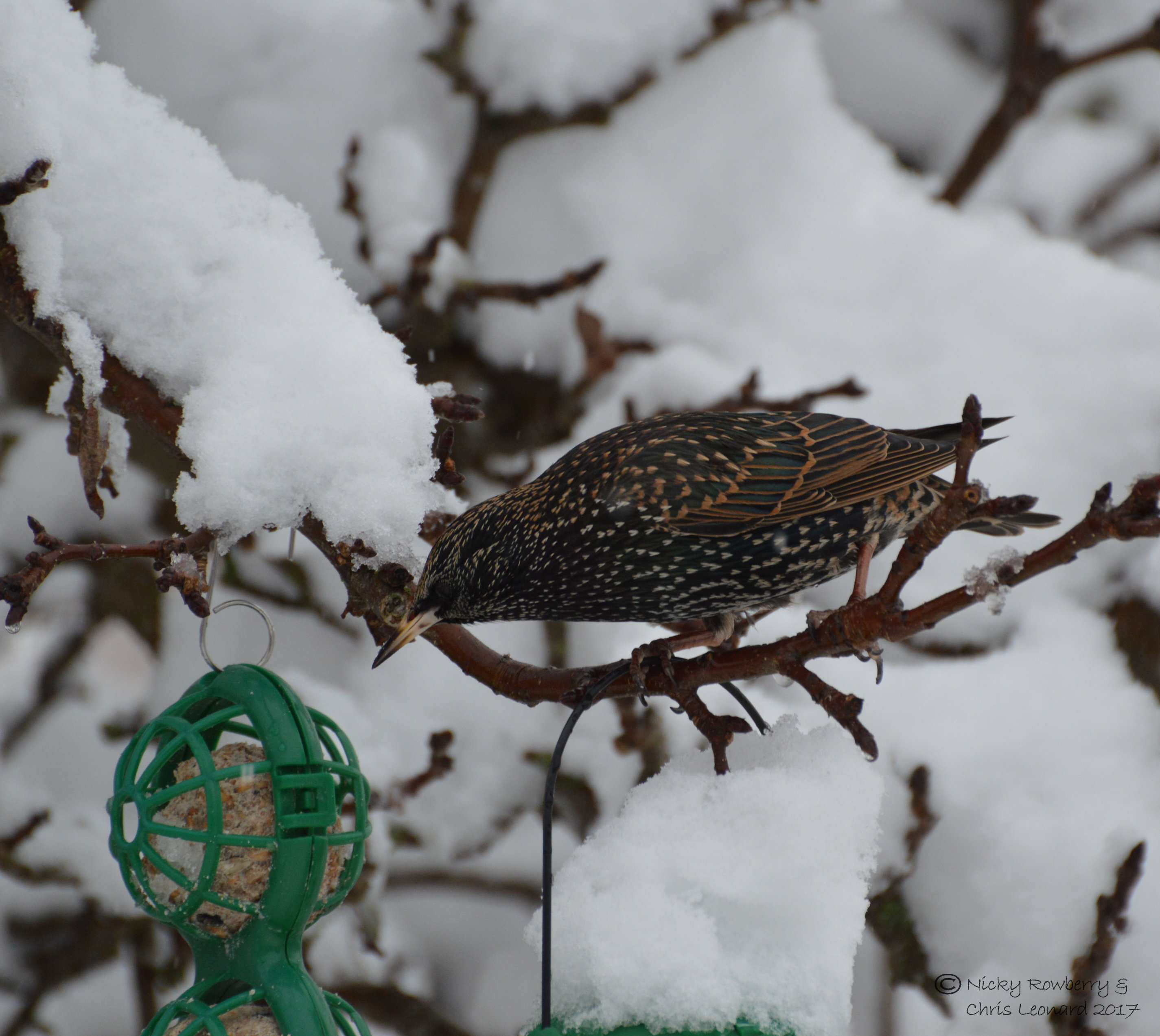
Most of our regular birds came out during my snowy vigil. Starlings, sparrows and blue tits were all abundant and didn’t seem bothered by me lurking behind my camouflage.

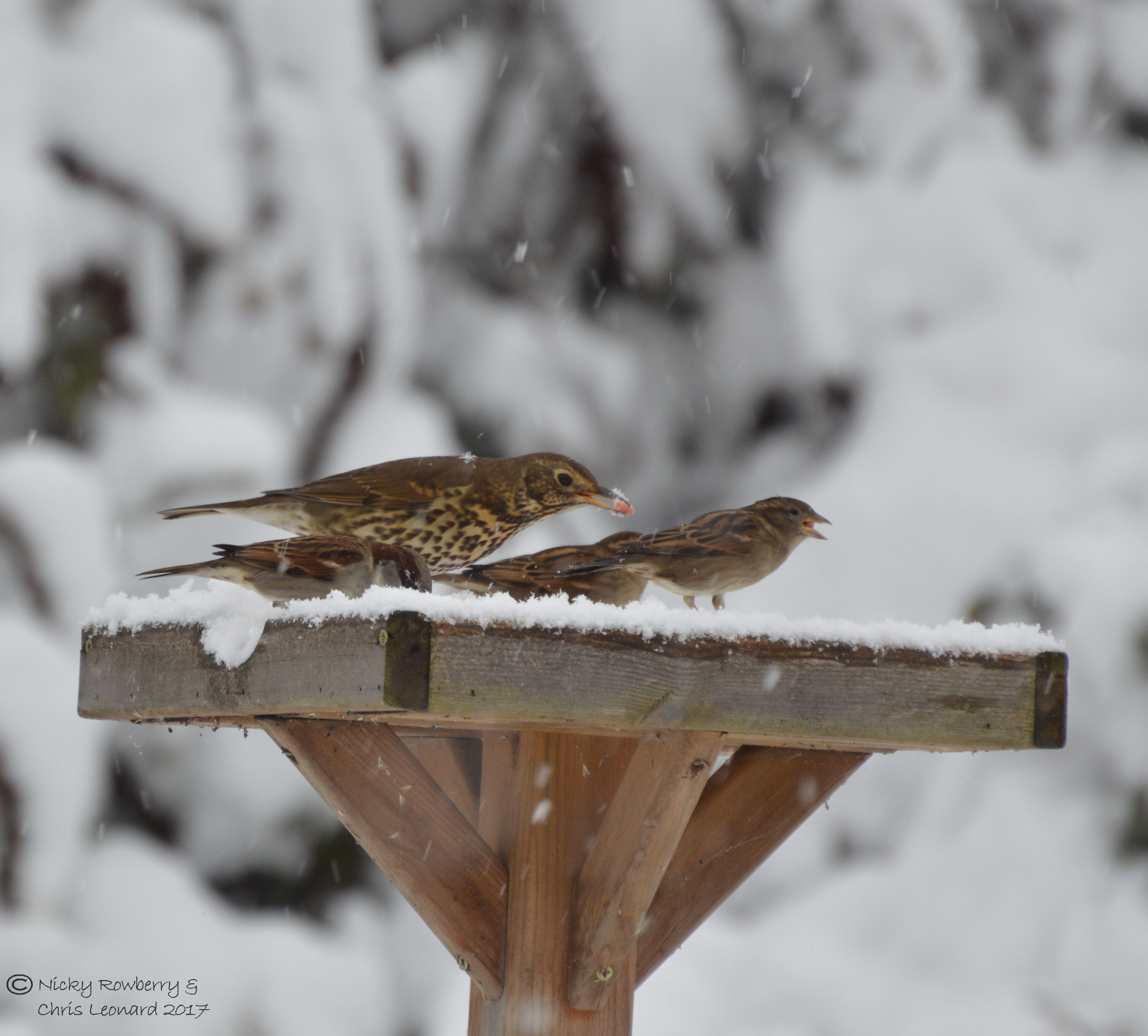
The wren was as elusive as always and the coal and great tits only came out when I went in. The blackbirds and jackdaws made the most of the food, but I struggled to get a decent photo of black birds against a white background. There were some surprises though – the benefit of sitting outside just watching meant that I saw birds I haven’t seen for a while in the garden. So it was great to see this thrush jostling for food amongst the sparrows on the bird table.

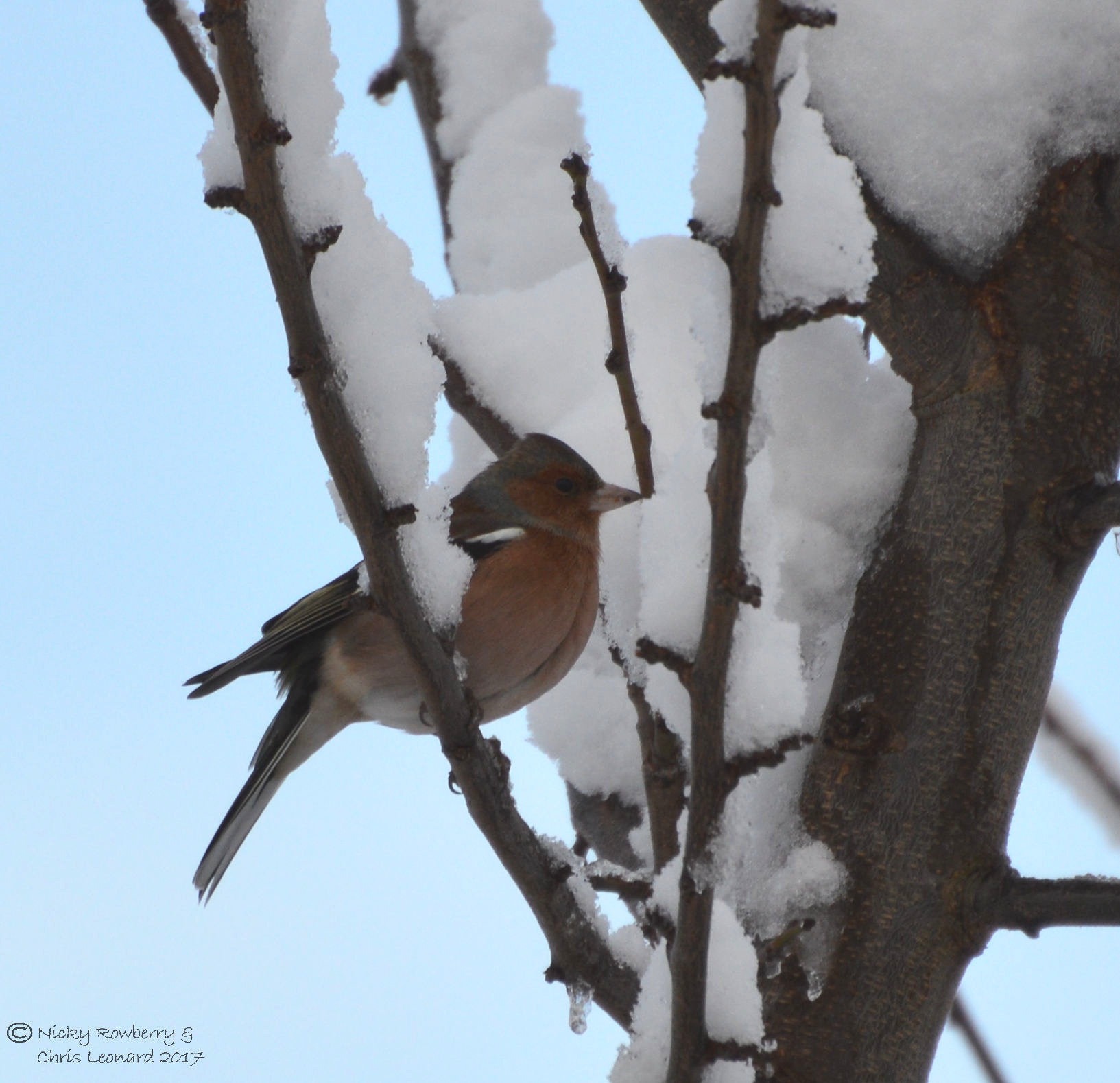
Even better a rare glimpse of a chaffinch – we hardly ever get these in the garden, so I was delighted to get even this distant shot of him.

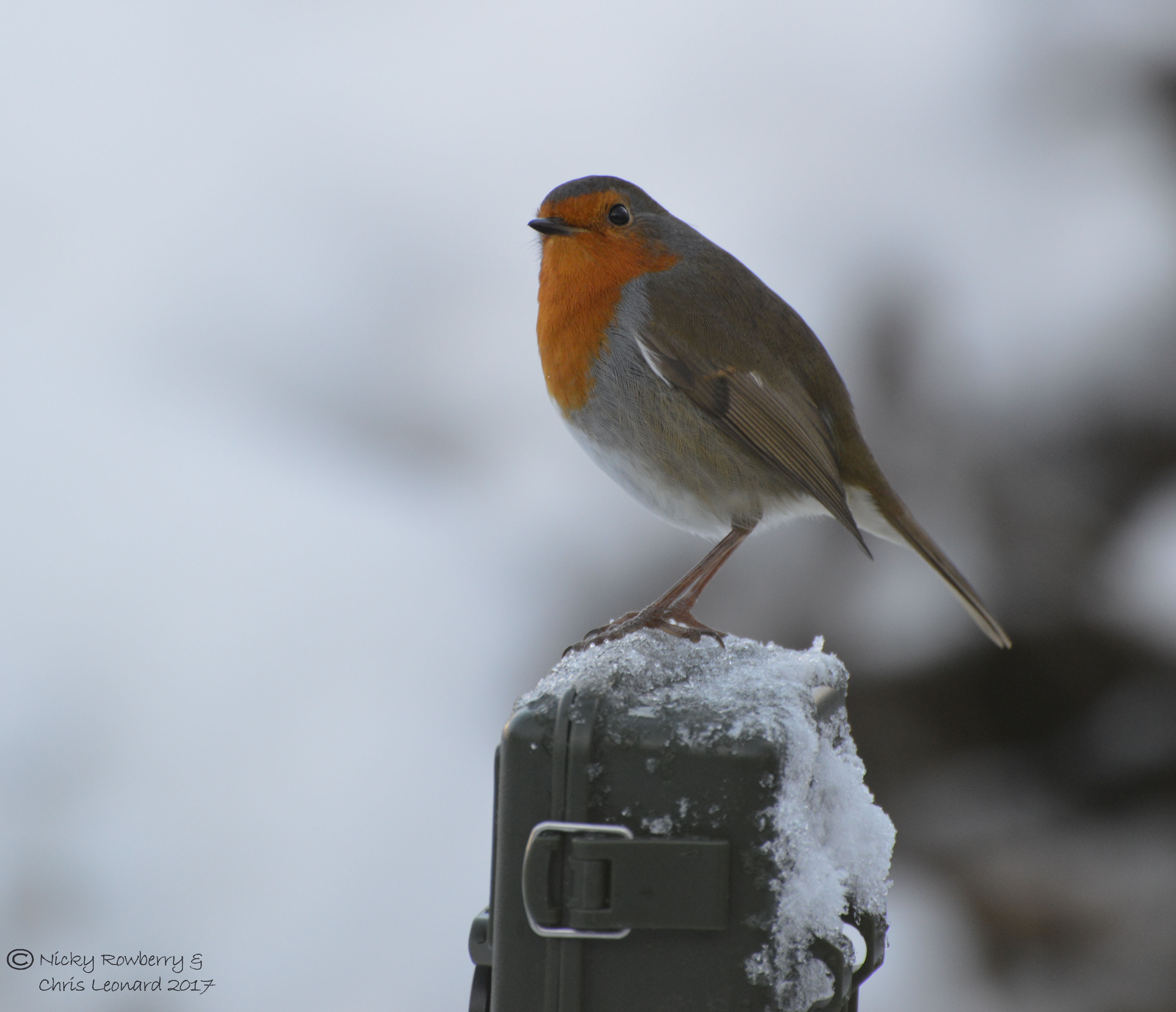
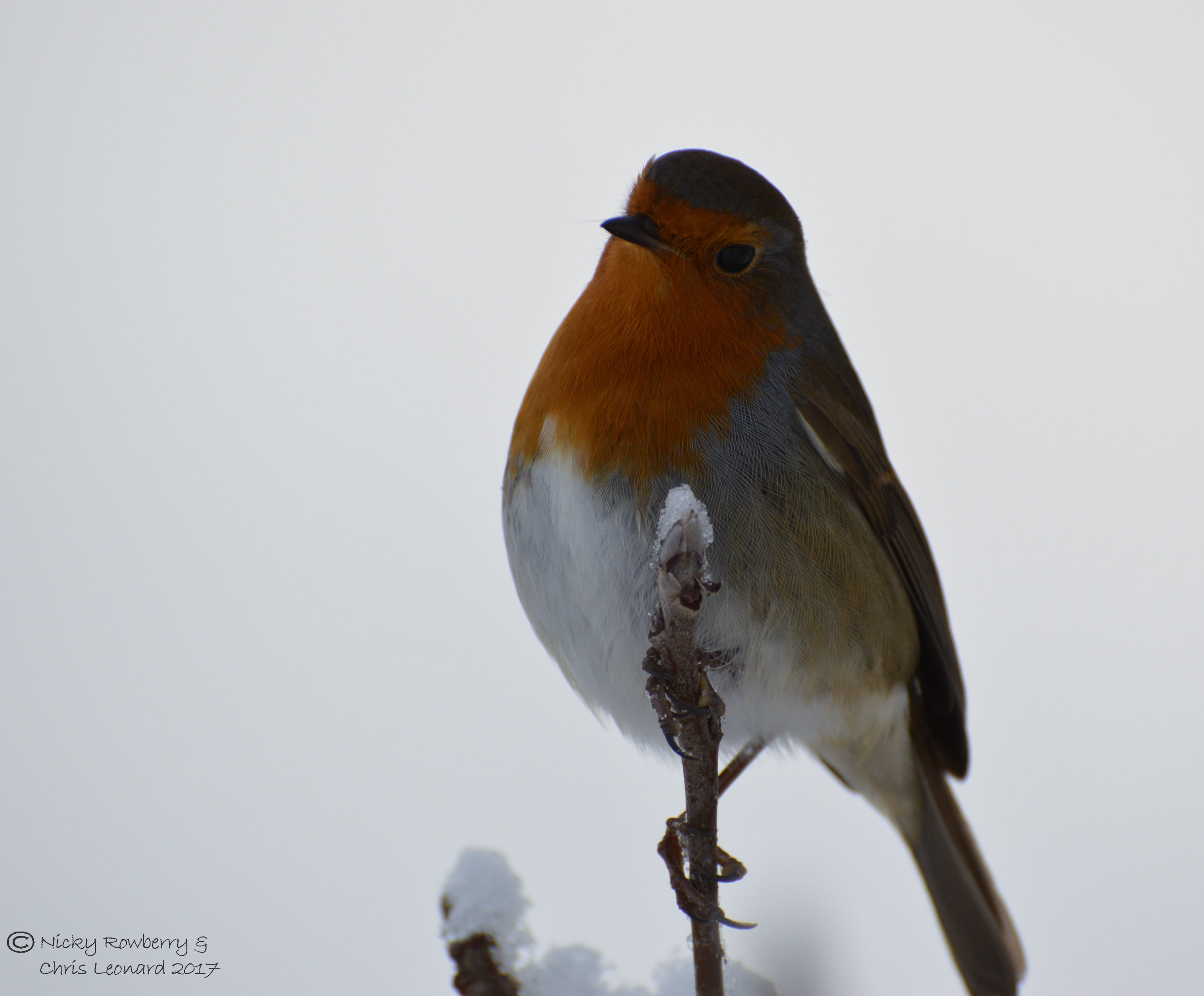
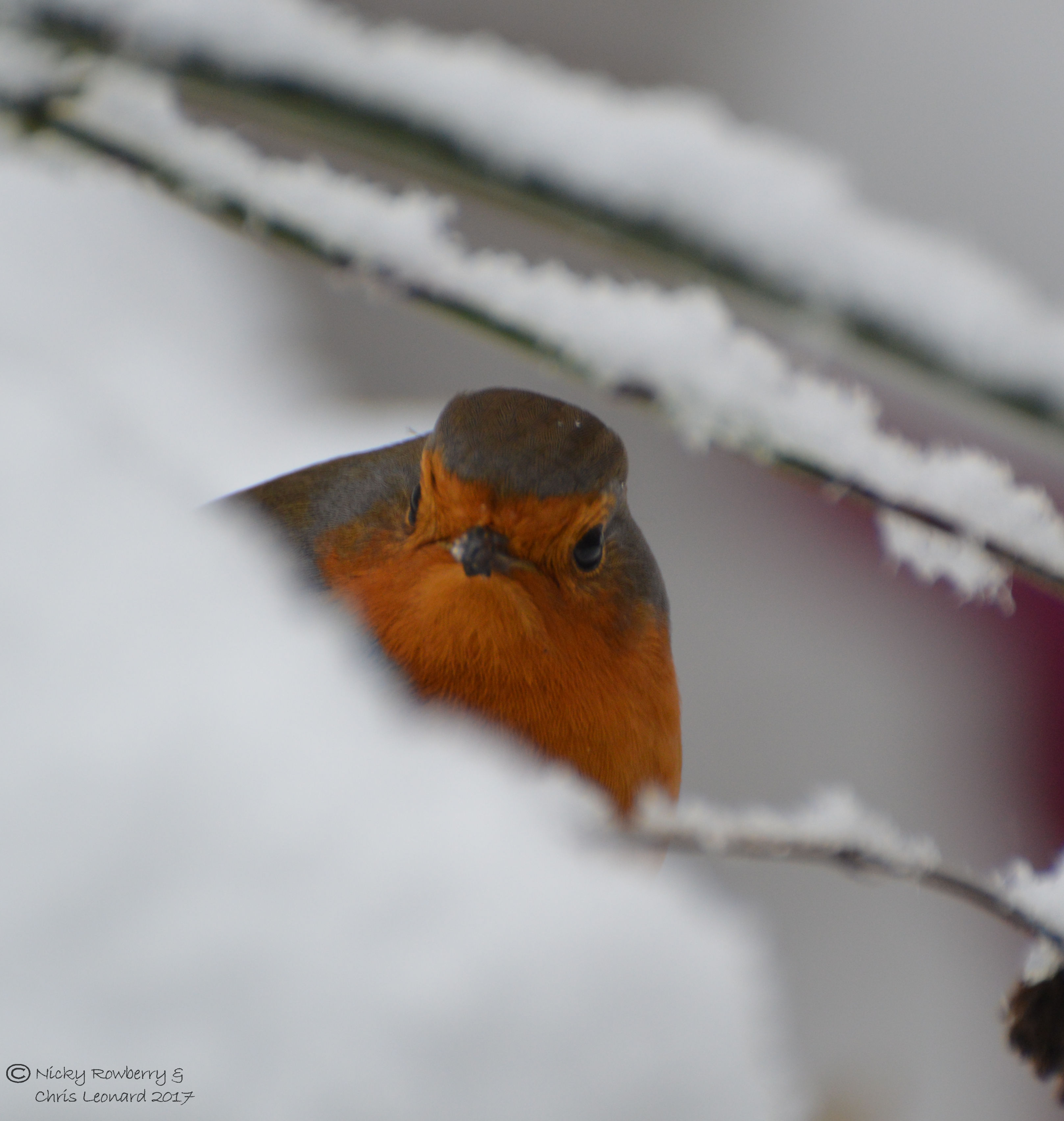
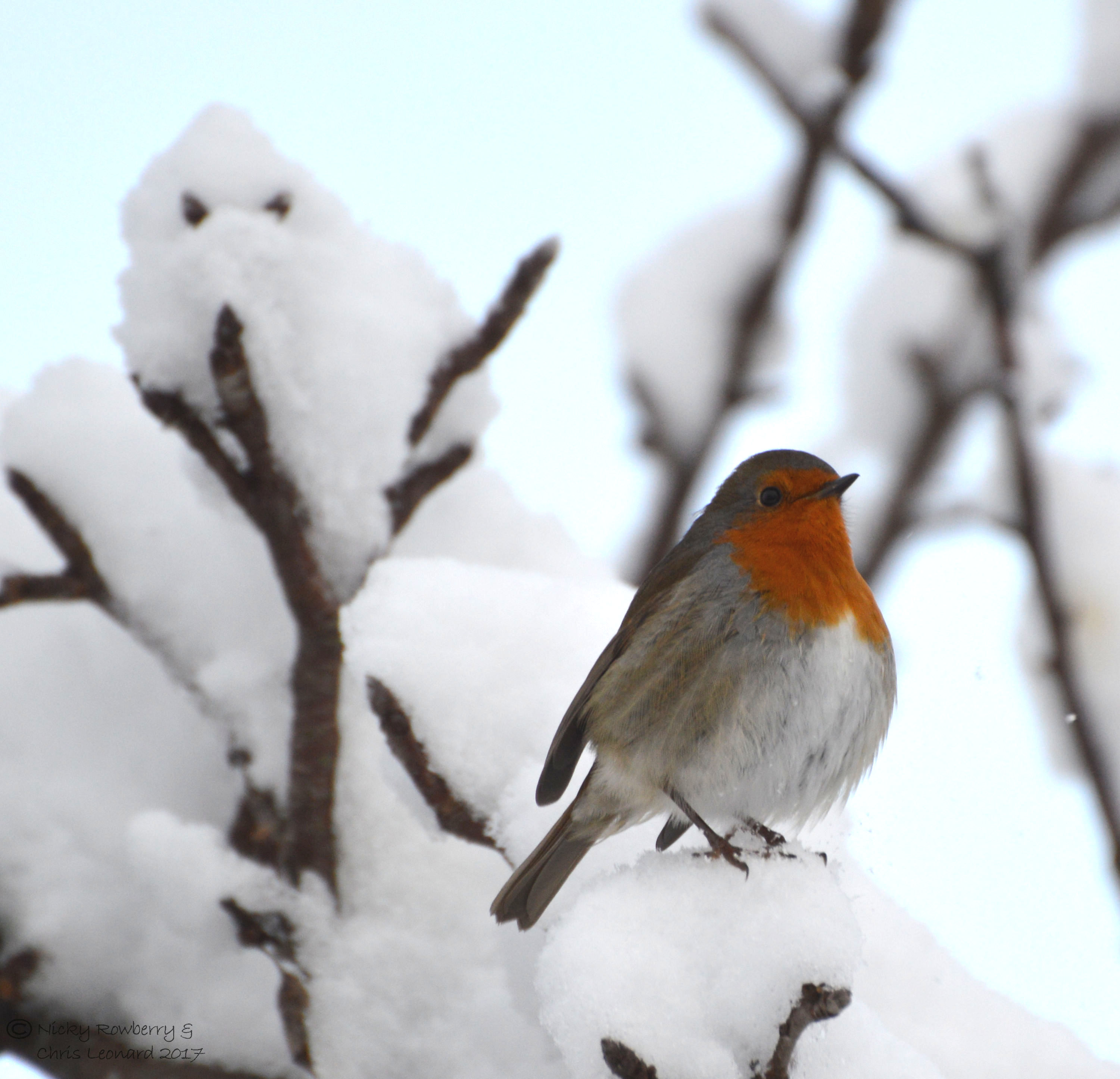
Of course the one bird I really wanted to get decent photos of in the snow was the robin. Fortunately we have two resident robins and one in particular is pretty brave and comes close up to me (not yet managed the holy grail of getting him to eat out of my hand yet, but I’m working on it). I took loads of photos of him – here are a few of my favourites. I think next year’s Christmas cards may be sorted!

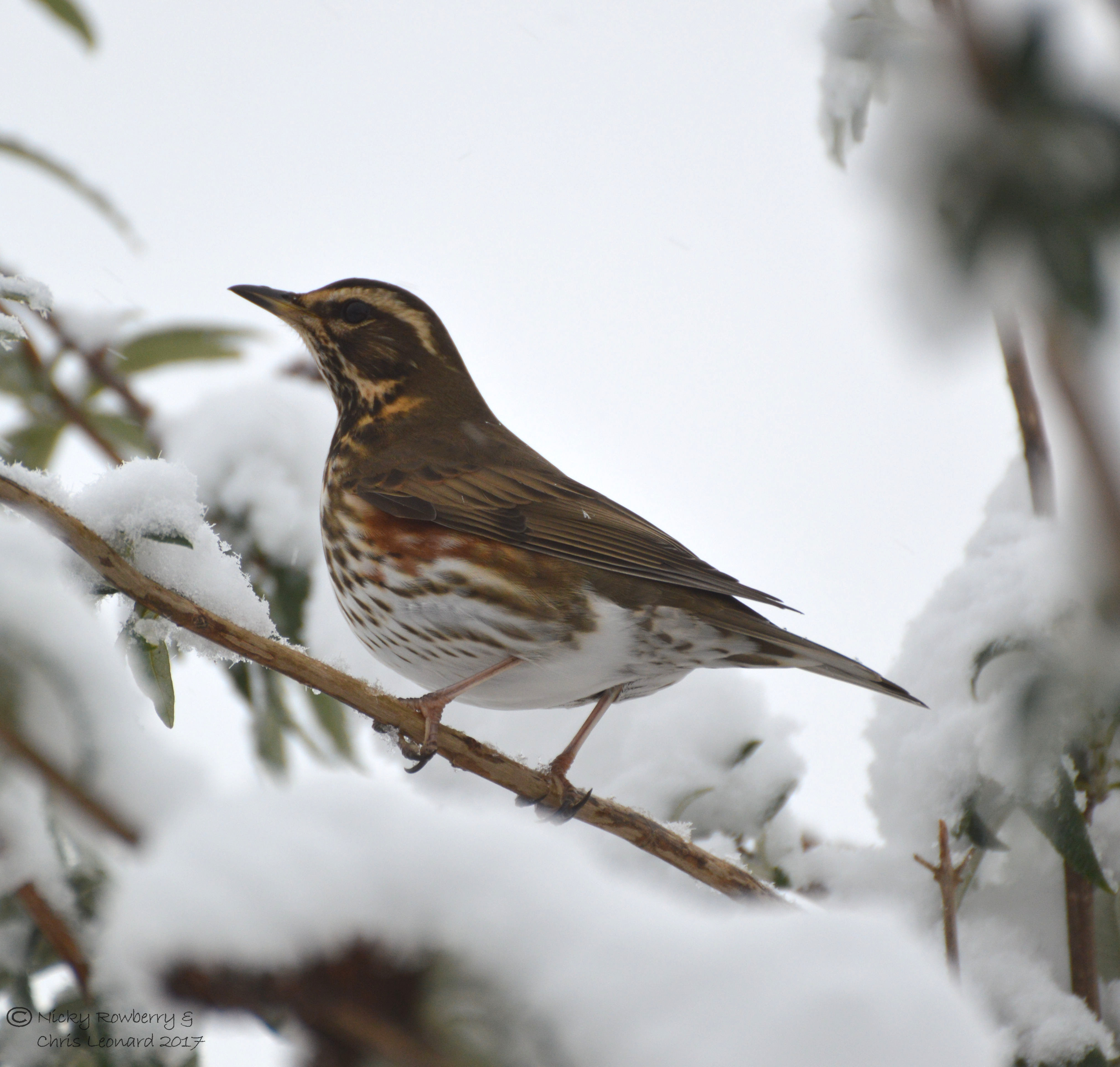
While chasing the robin round with the camera, I noticed something larger in the bush right next to me – a redwing. We haven’t seen any of these in the garden for a few years, so I snapped away quickly before he flew off.

And then it got even better! I was keeping an eye out in case the redwing returned and spotted a group of birds in next door’s tree. Unfortunately the tree was at the far side of their garden so I crept as close to our fence as I could get, peered over and discovered it was a small mixed flock of redwings and fieldfares.

They may not have actually been in our garden, but I’m counting them as I’m sure they must have passed through it at some point!

The final star of the show yesterday, although also not technically in the garden, was this magnificent Red Kite, drifting high above. I thought at first it was just the usual buzzard; it was only when I downloaded the photos I could see it was a kite. The perfect finale to my snowy birdwatching day.