Busy Birds

The birds are certainly busy in Malvern at the moment (as no doubt they are all across the country of course). There is a constant buzz of activity in the garden, be it gathering nesting material or just a feeding frenzy over the food we put out. The sparrows in particular have been keen on last year’s artichoke flowers for nesting material. It’s amazing how much they can stuff into their beaks, ending up with  ludicrously oversized moustaches!

Sparrow nesting material

In true Too Lazy fashion, we had left the old flowers standing thinking they would provide seeds for birds and maybe shelter for overwintering insects. I hadn’t realised they would make such good nesting material, but clearly the sparrows knew better. I’ve seen them plucking at the flowers in all weather, even when the high winds rock them about in the video below.

I already knew the blue tits had been checking out the bird box, so it was really nice to see this one taking nesting material in, although he or she did seem to be struggling a bit to get it all through the hole!

Birds of all sorts have been eating us out of house and home in the garden, hopefully building up their energy reserves for nesting. The blue tits regularly perform for the trail camera, but it was nice recently to get footage of the starlings and sparrows who have tended to be more camera shy. Being able to see the starlings close up like this you can appreciate what beautiful and colourful birds they really are – not just the plain black they can sometimes appear from a distance.

Starling on suet

The sparrows gather round the suet feeder in groups of up to about 8, although they can rarely manage to squeeze more than 3 or 4 on it at any one time.

There are still several species that have so far refused to be filmed although we see them regularly in the garden – Great Tits, Coal Tits, Goldfinches and of course the Sparrowhawk.
 

Out and About – Hartlebury Common

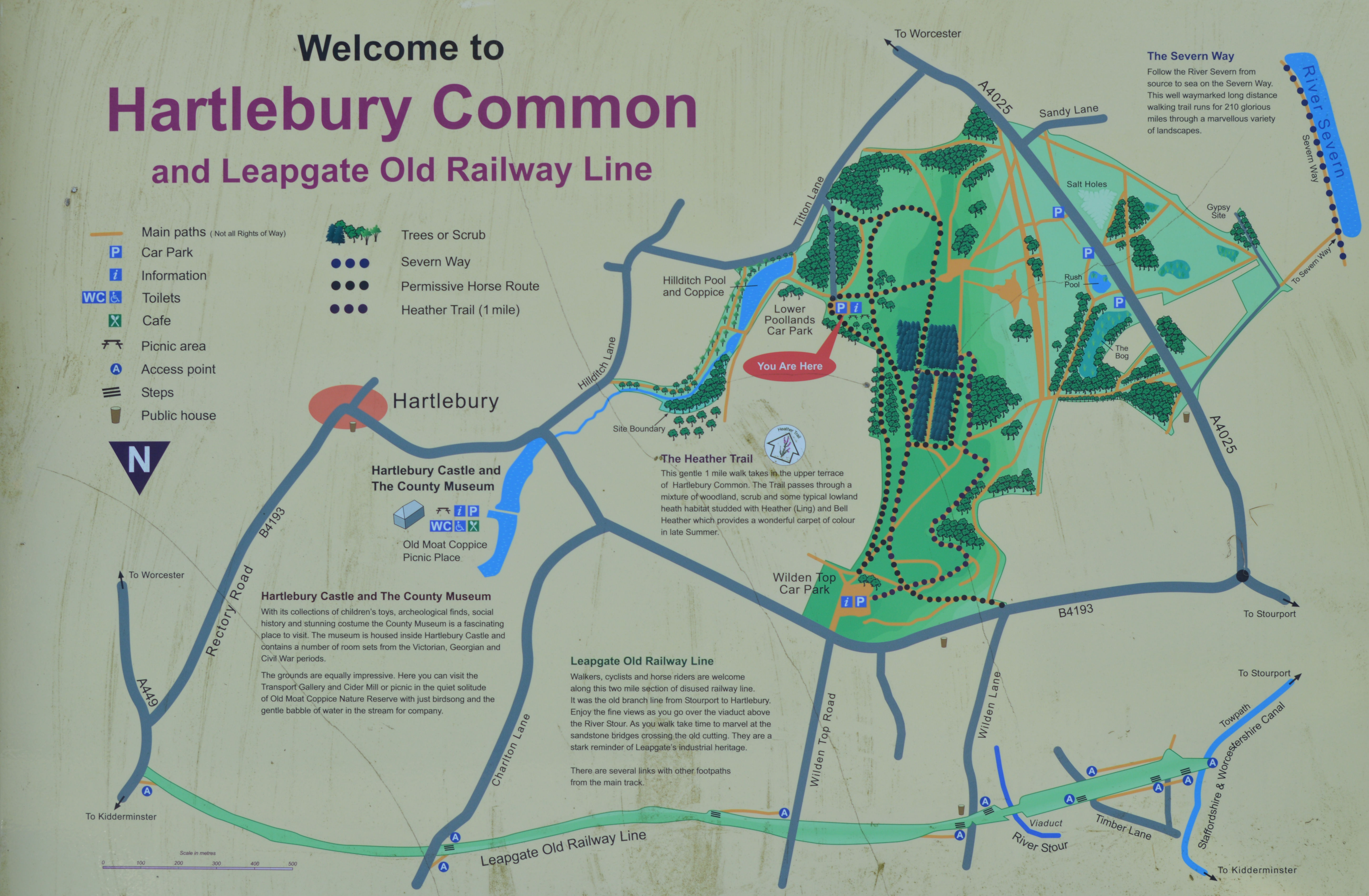
Once again we ventured forth from our sofas and hit the outside world in search of adventure – or more precisely moths! We’d heard that Hartlebury Common in North Worcestershire might have Emperor Moths – large day flying moths that we’ve always wanted to see. Hartlebury Common is an SSSI, consisting of lowland heath and supposedly good for Emperors.

Hartlebury Map

Needless to say after several hours tramping about in intermittent sunshine, there were no signs of the regal Emperors. Fortunately Hartlebury  provided other wildlife of interest. Insect-wise there were lots of bees feeding on the gorse and broom. A single Tortoiseshell butterfly provided fleeting hope that we’d spotted an Emperor; but a Bloody-nosed Beetle (Timarcha tenebricosa) stopped us in our tracks as he trundled across the path. When we tried to gently move him to one side, he secreted his trademark blood red liquid from his mouth, which made identifying him later a hell of a lot easier!

The gorse bushes also offered up a Gorse Shieldbug (Piezodorus lituratus) – a species we’d never seen before, so nice to bag another one.

The birds were abundant and singing all round us. A green woodpecker taunted us all morning, but remained steadfastly out of camera range. A tree creeper posed on a tree trunk just long enough for us to spot him, but not long enough for us to focus and get a photo. Fortunately a wren was slightly more accommodating, although a bit far away to get a really good shot.

Wren at Hartlebury

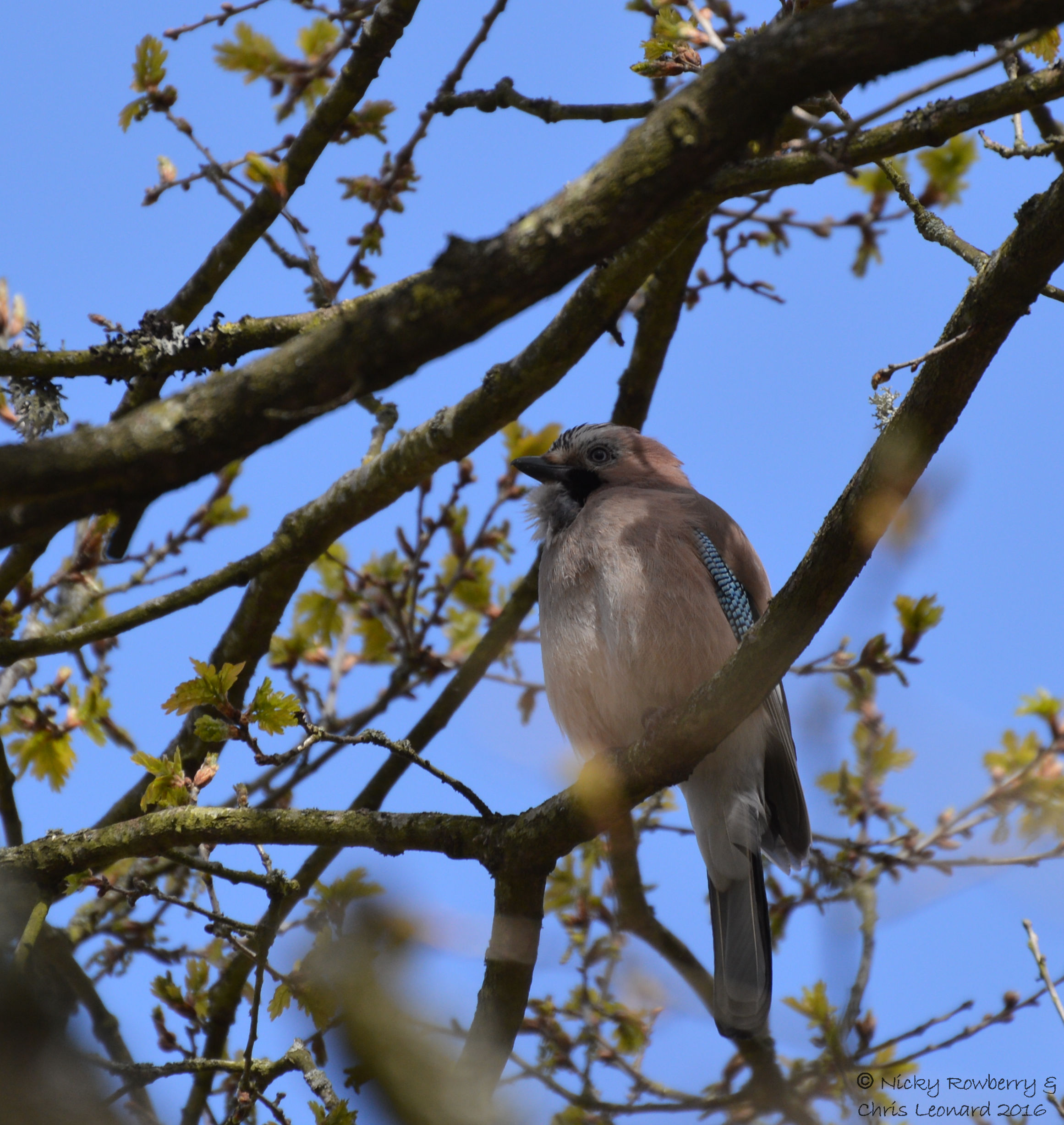
A pair of Jays made the trip all worthwhile though. I’d previously only seen glimpses of these beautiful birds, so to see them as clearly as this made my day.

Jay at Hartlebury 2

Jay at Hartlebury

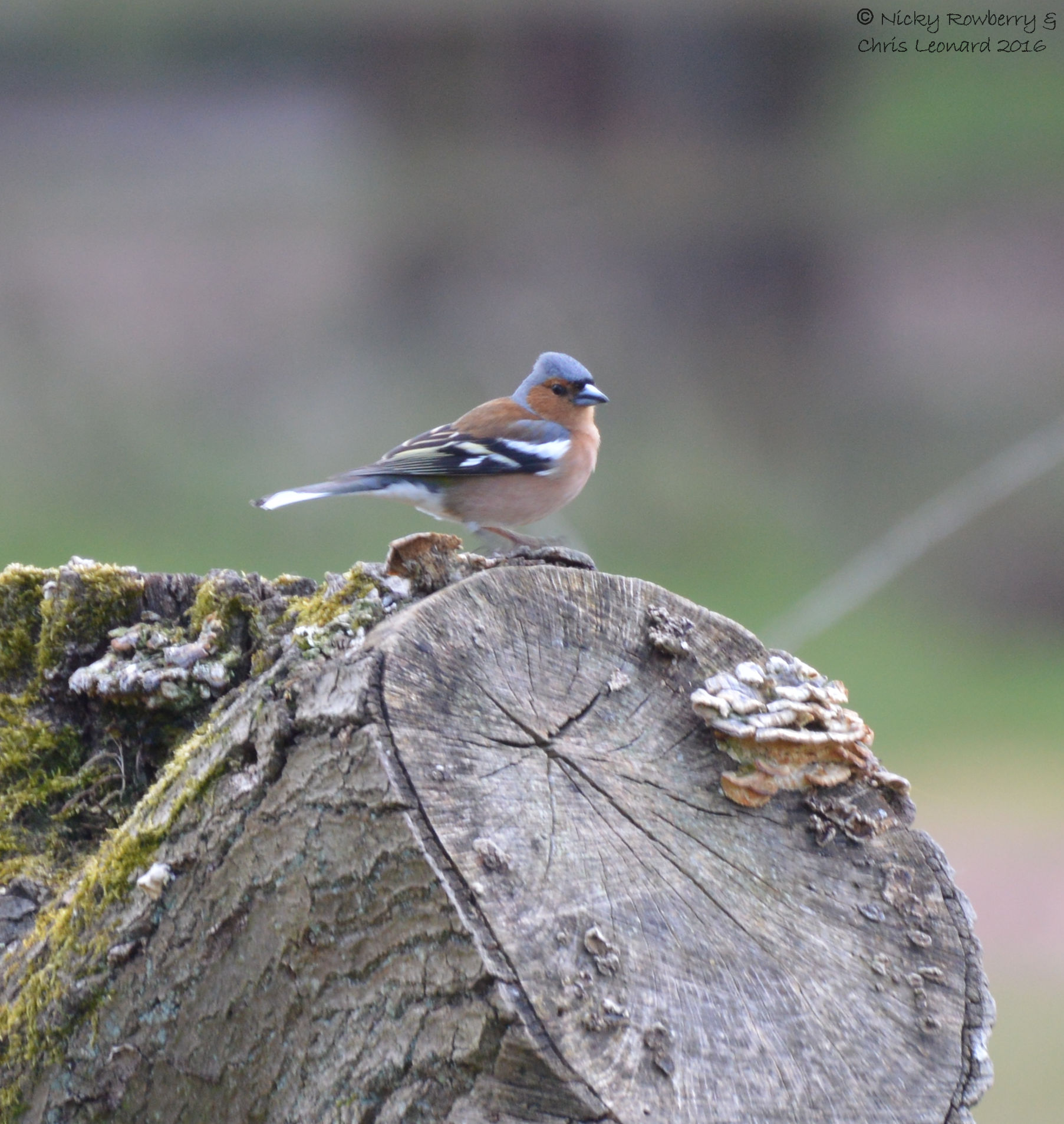
A chaffinch also posed perfectly on an old tree stump.

Chaffinch at Hartlebury (2)

The final bird of the day was either a Chiffchaff or a Willow Warbler. Apparently the two are very similar and the best way to tell them apart is by their songs. Of course we were so intent on taking photos, that we didn’t really pay much attention to the songs. Back at home and listening to sample bird songs on “tinternet”, I still couldn’t decide if we’d heard a Chiffchaff or a Warbler. So if anyone can confirm the bird by appearance alone and settle it, that would be great.

Chiffchaff (11)

Having never before stood under a pylon (slightly incongruous in the middle of the Common), I thought I’d attempt an arty shot – not sure I’ve really got the hang of art though!

Pylon at Hartlebury

So Hartlebury Common may not have offered up any Imperial sightings, but there was plenty of interest to while away a few hours.


A Teasel’s Life

Bee

I don’t know how we originally came to have teasels – none of the immediate neighbours grow these giants, but the seeds must have blown in from somewhere (and we may not be popular as they blow out again each year!). They have become a bit of a fixture in our garden and a very welcome one for all sorts of wildlife.

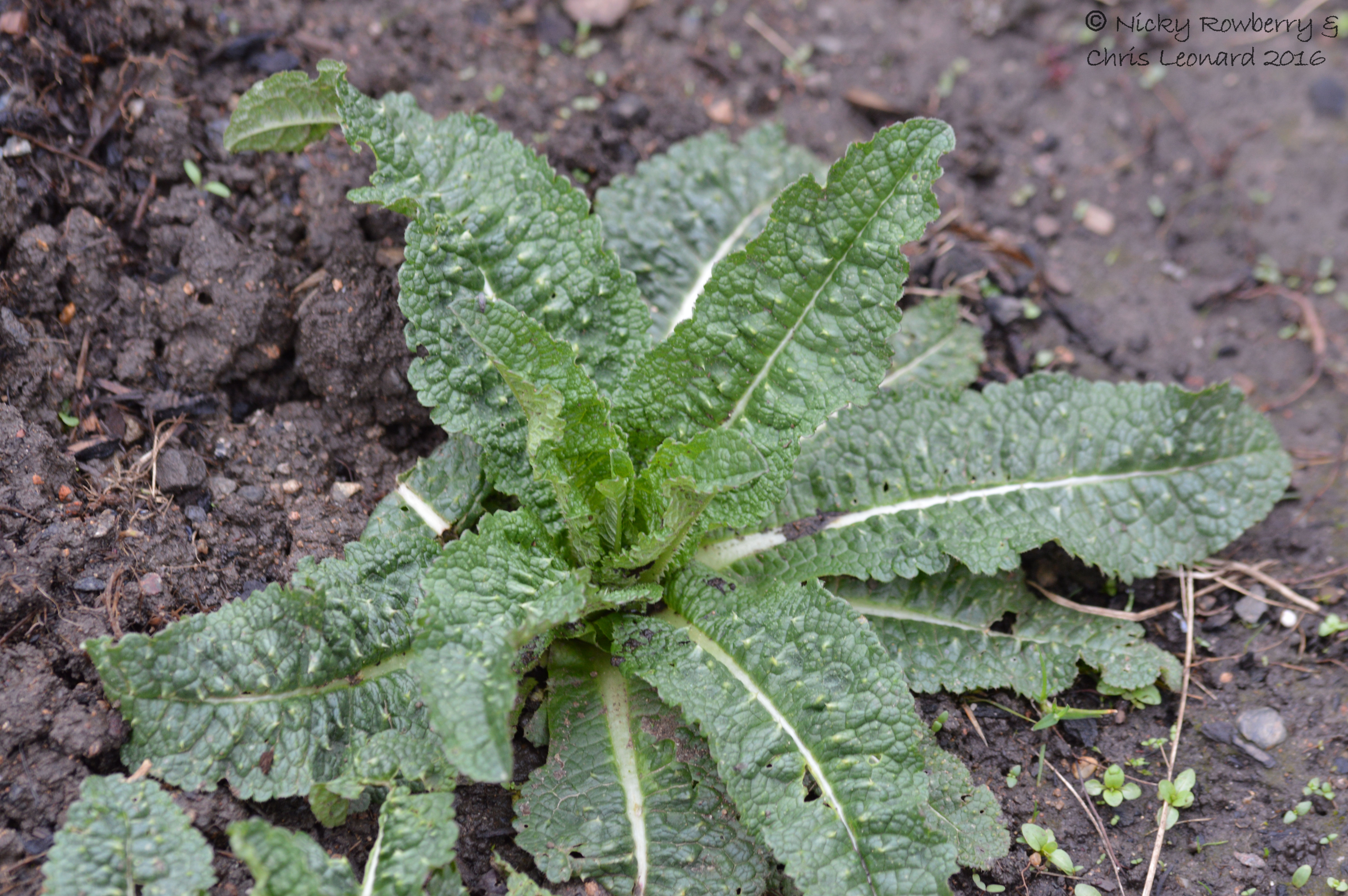
They start off as fairly non-descript plants, forming low growing rosettes that look like they might turn into at most a thistle type of thing. They only flower in their second year, so I’m hoping the ones below, that I think overwintered, will flower this summer.

Baby Teasels

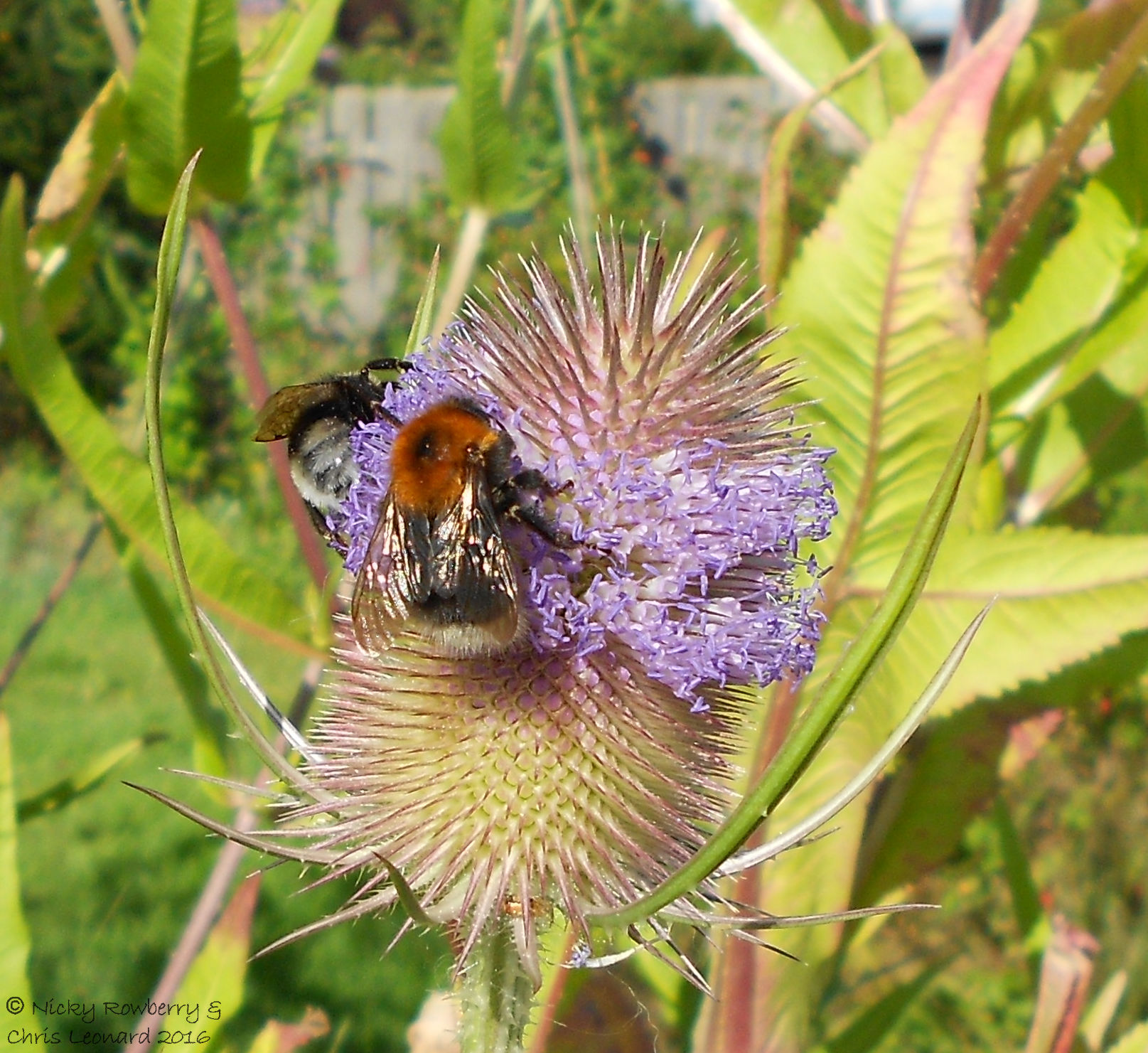
When they do put on their growth spurt, they are easily taller than me (I only manage a mere 5 foot 1 on a good day!) Their flowers are irresistible to the bees in the garden, which is the main reason we let them grow every year. These ones below are full grown ones from previous years

Bees on Teasels

Bees on Teasels 2

The stems and leaves provide homes for lots of other insects too, with water tending to collect at the base of each leaf.

We always leave them once they’ve finished flowering, as they still provide benefit right through the winter. For us humans they provide structure and interest in the garden.

Frosty teasel 2

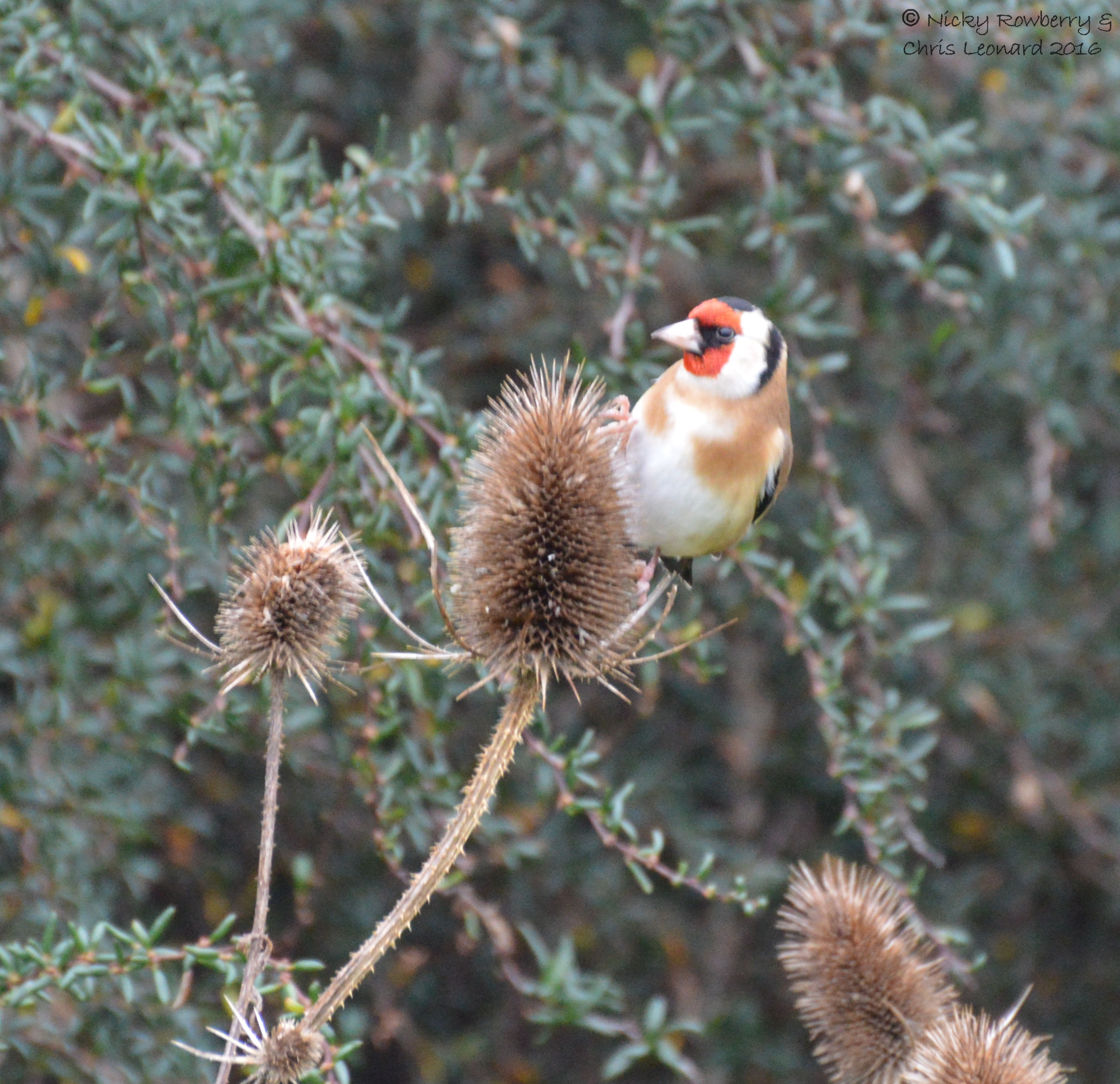
The teasels themselves are packed with seeds that the birds love. Goldfinches are well-known teasel fans, but we’ve seen several other species such as this Coal Tit making the most of them too.

Goldfinch 1

Coal Tit on Teasel

Of course we do eventually have to chop them down, if only to provide space for next year’s crop. This year we decided to save some of the hollow stems and turn them into something useful – a Bug Hotel. The RSPB are running a “Give Nature a Home” campaign, so a pile of teasel stems and an empty squash bottle later and we have hopefully made one small home. With a bit of luck we’ll be able to post photos later in the year of some new residents.

Teasel canes

Bee Hotel

So that’s the life of the teasels in our garden – the plant that keeps on giving to wildlife – even when it’s chopped up into pieces!


Dunnock Dating

The dunnocks in our garden are clearly getting frisky. They’re normally quite shy birds staying out of sight in our plentiful undergrowth, but this week I caught them displaying in a quite amazing fashion. (Look away now if you don’t want to see parts of a dunnock that are maybe best left to the imagination!)

I caught this pair outside the patio doors while I lolled on the sofa – fortunately for once a camera was within reach. As I hadn’t been anticipating a photo shoot, conditions weren’t ideal – I had to try and focus over the coffee table and dodge the cat’s scratch post; both of which obscured my view a bit, but I didn’t want to move and alert the dunnocks to my presence. So apologies if the photos aren’t quite as sharp as I’d have liked.

Dunnock pair

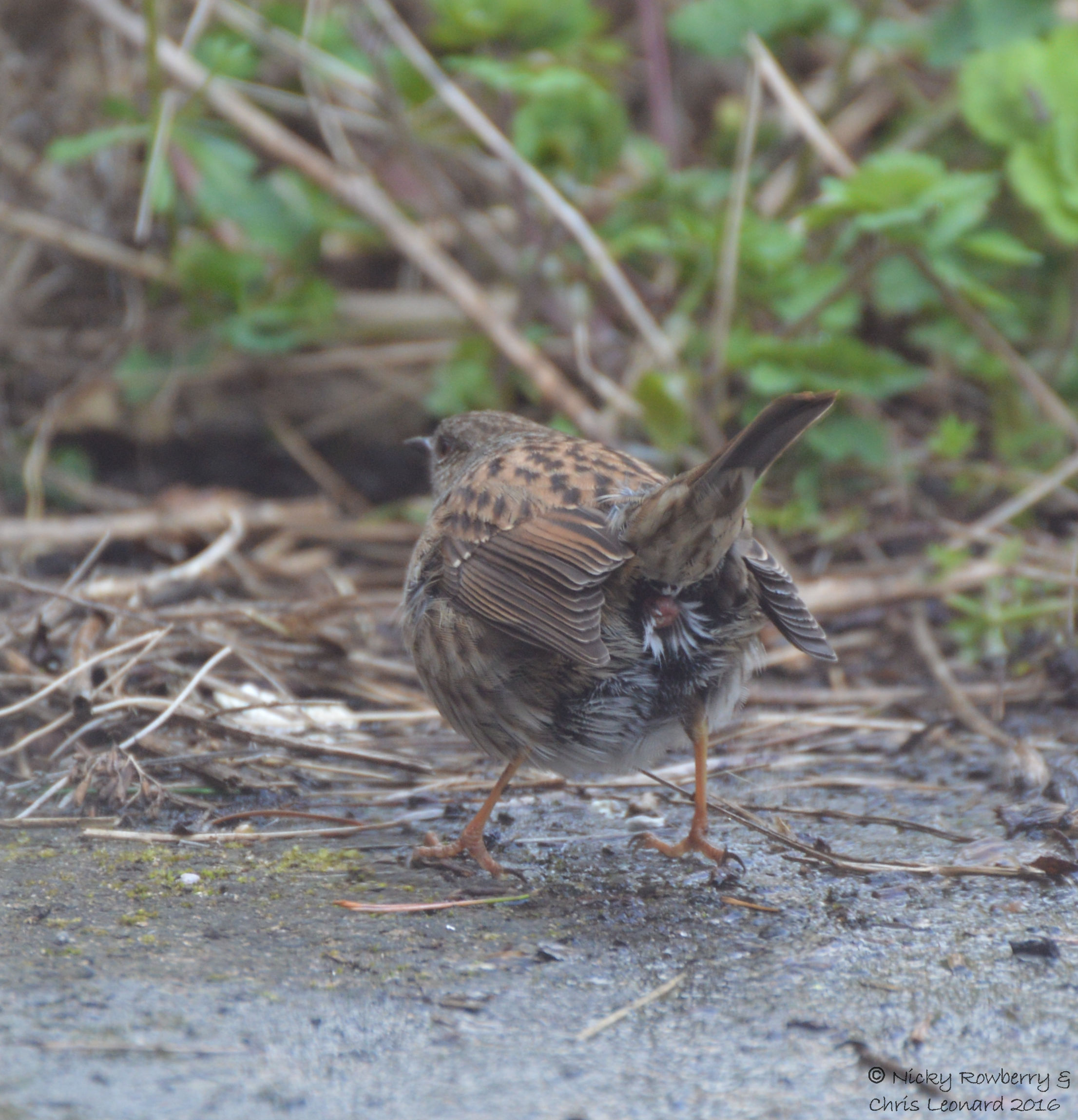
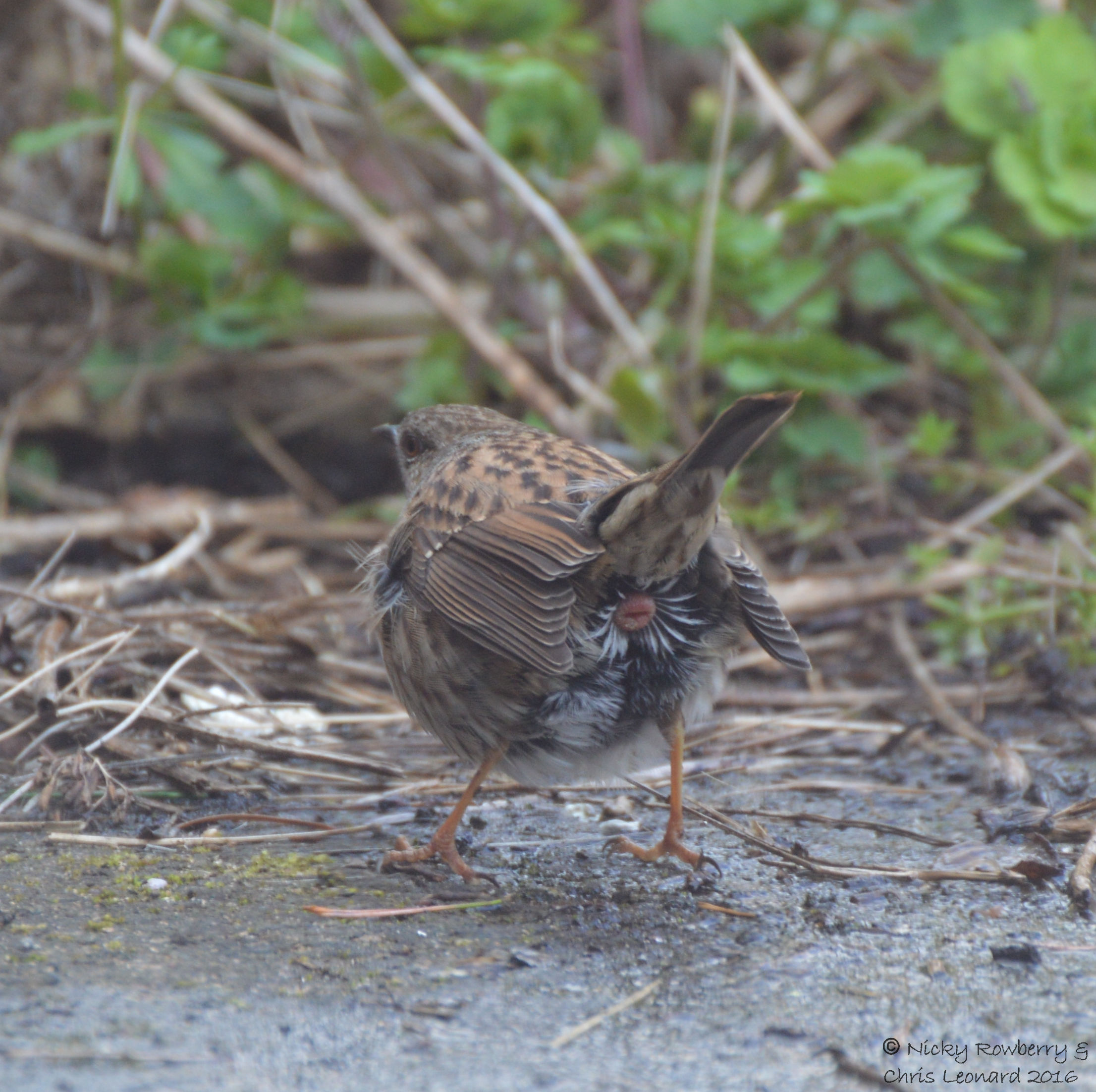
I thought at first the pair were just rooting about for food – and indeed that did seem to be what the male was mainly interested in. But the female started behaving very oddly. I thought at first there was something wrong with her – she seemed to be repeatedly straining her rear end (cloaca as I’ve since found out) while fluffing her feathers at the male. He didn’t seem particularly interested in her antics – can’t say I blame him, it wasn’t an attractive dance she did! The photos show her rear end in various stages of flexing (I did warn you to look away!)

Dunnock closed

Dunnock half open

Dunnock open

A quick bit of googling revealed that female dunnocks may mate with more than one male and that the males will peck at her cloaca to get her to eject the previous male’s sperm. This female seemed to be actively encouraging him to do so. I’d never heard of this behaviour, let alone seen it.  So you learn something new every day – even when just lolling about on your sofa!

Baby Blues (hopefully)

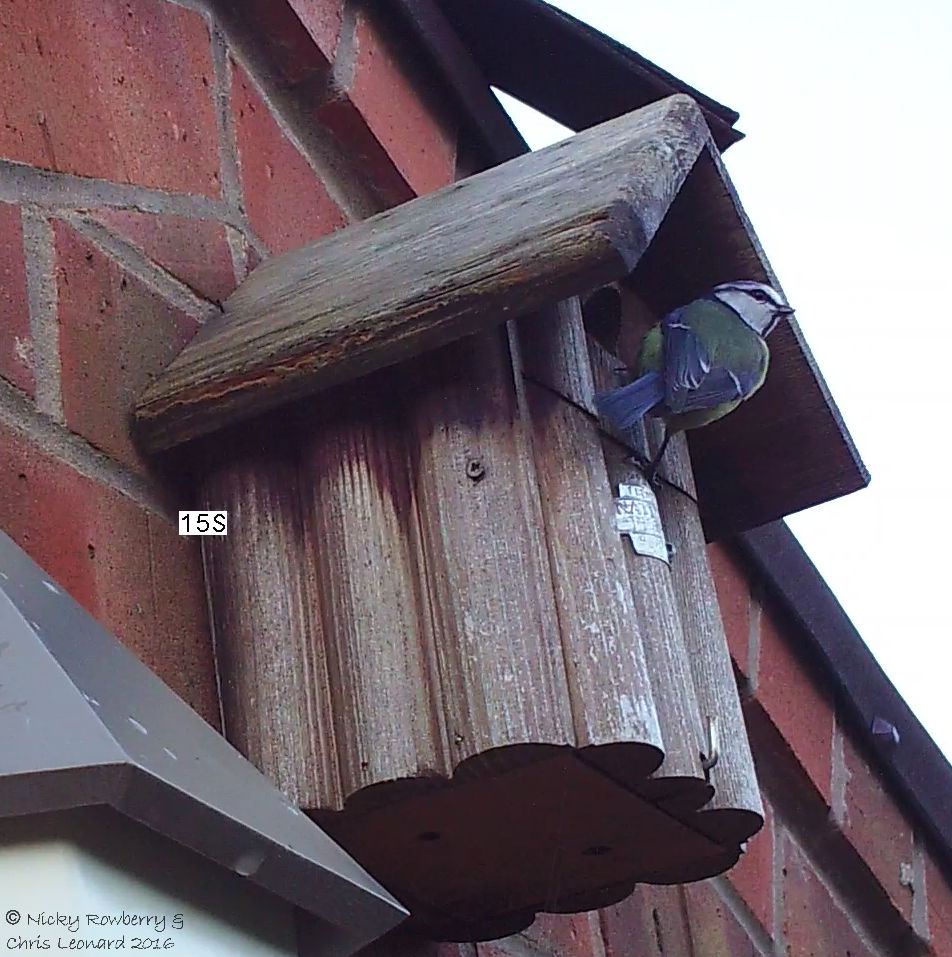
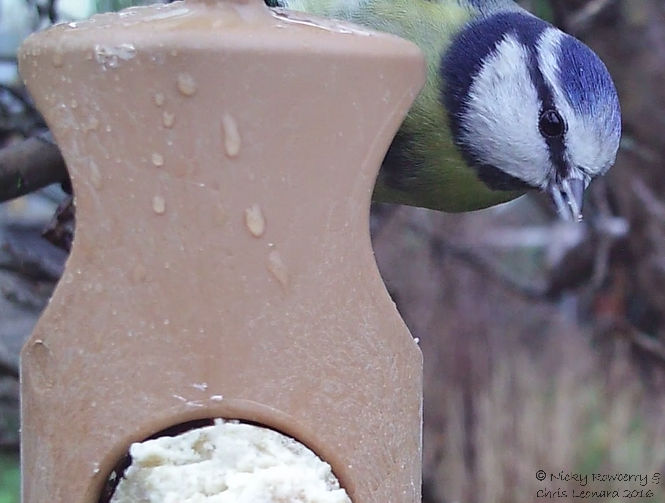
In the last couple of weeks the posts seem to have been colour themed, first red, then yellow and now blue! The big blue news is that the Blue Tits are nesting!! So excited to see them using the bird box (the old one of course – they’ve turned their beaks up at the new deluxe one!) The brief video clip below shows both adults flying in and one exiting again. I think at this stage they were still making the nest as we saw them with nesting material.

The photo below is a still taken from the film. Hopefully things will go well for our pair and we can give updates on their progress – fingers crossed for a successful fledging and baby blue tits.

Blue Tit on Bird Box


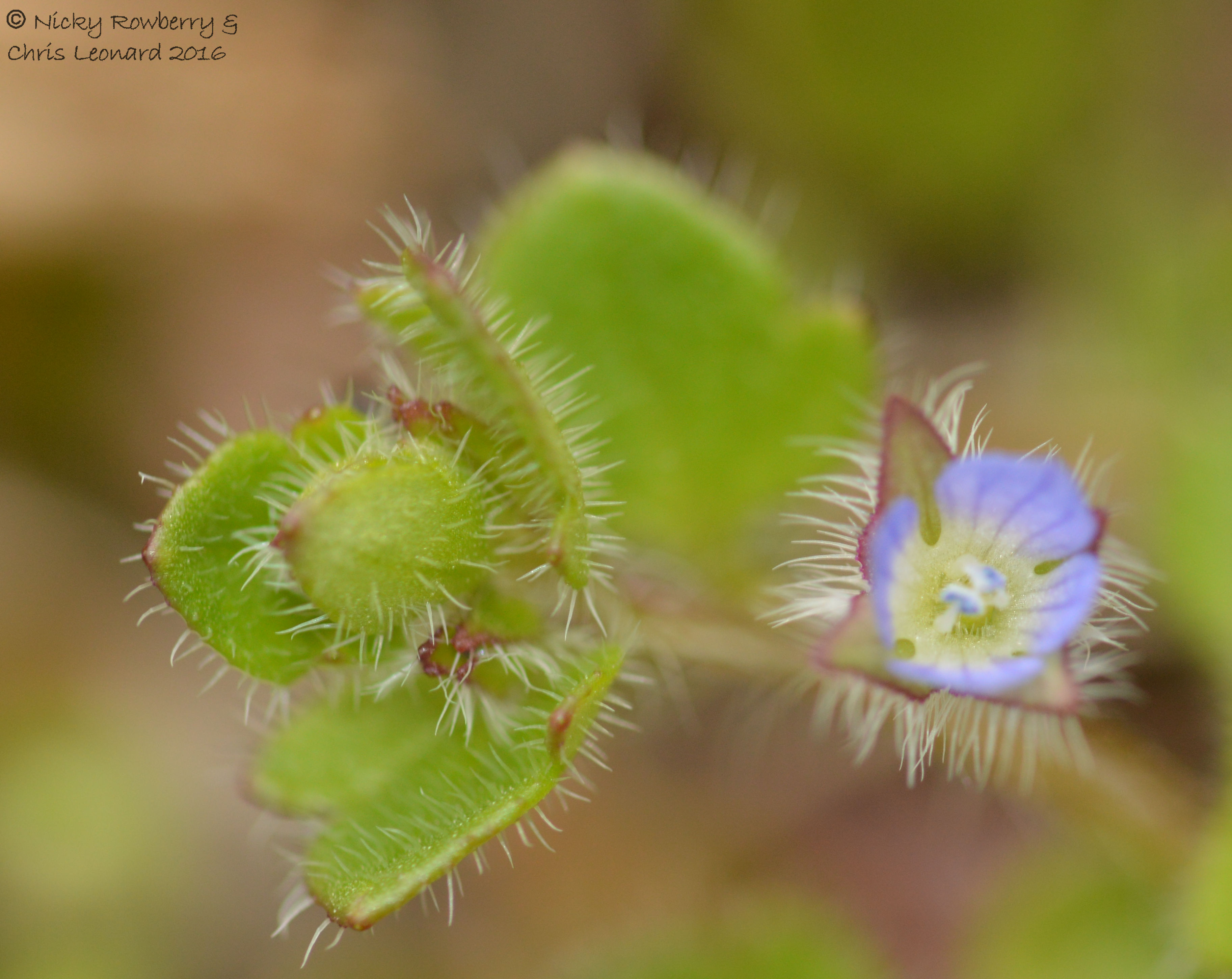
The blue tones seem to be spreading round the garden too, with the emergence of several  blue hued flowers. Today I spotted these tiny Speedwell flowers hidden amongst the grasses. Not the easiest to photograph as they are so damn small. I didn’t realise they were so hairy either until I downloaded the photos.

Speedwell

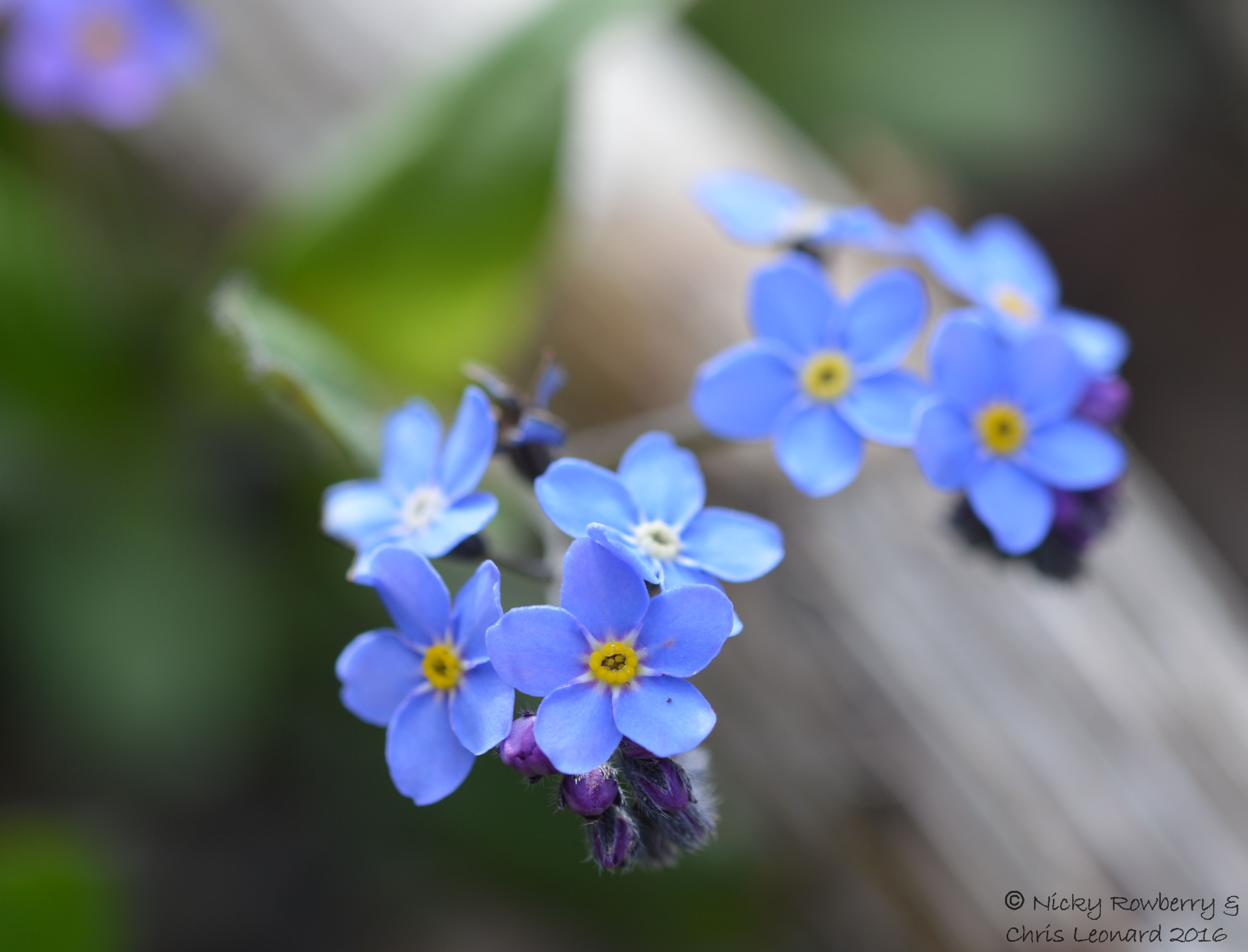
And finally, no blue post would be complete without Forget-me-nots. These bright little flowers have been a favourite since I was a child (many moons ago) and are a sort of unofficial totem for Too Lazy To Weed. They spring up wherever we haven’t weeded – so pretty much over the whole garden!

Forget me not


Siskin Surprise

The wildlife interest in our garden seems to be swinging at the moment to and fro between the moth traps and the trail cam. Last weekend the trail cam definitely came out on top though, when it threw up a complete surprise in the garden. I guess many of us put out these cameras with the vague hope that they will reveal something unexpected and this weekend ours did. It may not have captured anything super rare, but it did film a Siskin – a bird which we didn’t even know we had in the garden. Of course it would have been nice to see the Siskin in the flesh rather than just on film, but at least we know now to look out for it!

We’d hung this bird table out a week or so ago and were initially a bit annoyed that its design meant it immediately swivelled, tipping all the seeds into one corner.  But this jaunty angle actually appears to be working to our advantage, as the slope (and general instability) seems to be deterring the pigeons and larger birds and allowing the smaller ones to get a look in.

The Siskin is an attractive bird, so I tried to get some correspondingly attractive still images from the film. Unfortunately it was so intent on scoffing the sunflower seeds, that it was difficult to get an image without food hanging from its mouth, so these were the best I could do.

Siskin 1

Siskin 2

The sloping feeder attracted several other species that afternoon, although none stayed as long, or were quite so fond of their food, as the Siskin – a bird after my own heart!

Great Tit

Robin 3


Birds in Focus

At last I’m finally getting some photos that are not only in focus (just about), but have real live animals in them – a dream come true after a couple of weeks struggling with the new trail cam!

Blue Tit trail cam photoI still wouldn’t claim to have mastered it, but the learning curve is definitely on the up. My new 250mm close up lens has certainly helped get (not surprisingly) closer images. The downside of using this lens is that your field of view shrinks dramatically, so you’ve got to be sure you’re pointing somewhere where there’s going to be some action. For some reason I seem to nearly always position the camera slightly too low, so I’ve got lots of clips now of bird feet, while their heads tuck into the bird food out of sight of the lens! I’ve also got a lot of clips of branches shaking, as something lands just above the field of view – I swear sometimes the birds are just sitting there, rattling the twigs to torment me. This underestimation of the required lens height may have something to do with my own height (or lack of), but I can hopefully train myself out of this one.

I’ve been much more impressed with the quality of the video clips than the still photos. But what I have found is that I can often get pretty good snapshots from the videos and turn them into photos. The images of the blue tit above and long-tail tit below were both taken this way.

Long tail tit 250mm lens


I tried the new lens out in the garage on the mice and was delighted when it captured two of them for the first time.

Two mice trail cam imageAt least I think I’m delighted, although maybe I won’t be so keen when 2 mice become 4 become 8 etc. They are getting through a lot of bird food as it is. Putting out the trail cam these last few weeks has incurred incidental expenses that I hadn’t anticipated when I first got it. In order to maximise photo ops in the garden, I’ve increased the numbers of bird feeders, so have of course needed more bird food too. There’s also been the additional lens, plus a new ground spike for the trail cam that I hope to try out at the weekend, to get photos of some of the ground feeding birds.

I’ve also been forced for the first time in ages to do a bit of judicious pruning round the garden to get clear shots of the feeders – that tree has just too many twigs growing specifically it seems with the intent of ruining my photos! I’ve been down on my knees trimming bits of grass out of the way of that elusive perfect shot and moving stones and other debris that spoiled the look. At this rate I may even find myself weeding the garden!

But I’m sure it will all be worth it come the spring. We’re really hoping that the blue tits will nest in the bird box again this year – in which case I will be poised ready with my new trail cam skills to capture the moment. Not sure when blue tits start nesting, but spring feels like it’s on its way. Despite a very cold night last night (-4.2°C according to my latest toy – a max/min thermometer for the Garden Moth Scheme), I heard the first froggy croak in the garden this afternoon and the daffodils are almost out, so hopefully the blue tits will feel it too.

In the meantime, here’s a couple of short films of the ever-adorable Long-tailed Tits in the garden today. First film is taken with the 460mm lens and second with the 250mm.


Of Mice and Apples

I decided to play dirty this week in my ongoing attempts to capture wildlife footage with the trail camera, so offered bribes to the mice in the garage. We had a load of apples and some cheapo cake from the supermarket,  so I thought I’d see what the mice made of them. The mice clearly don’t take after their garage owner, as they went straight for the apples first and only ate the cake once all the fruit had gone. They must have been really keen on the apples too, as they triggered the camera within 5 minutes of me putting the food out. The first film shows one determined to drag a piece of prize fruit back to his nest – it took him 4 attempts before he managed to carry one off. I am slightly worried that this now means I’ve got a stash of rotting apples somewhere in the garage, so I hope they eat all they’ve carried off.

The video was shot using the 460mm lens and isn’t quite as sharp as I’d like (having seen other bloggers’ much better images), but it’s not too bad.  I’m still practicing getting the camera set at just the right distance and angle. I did find a very useful video tutorial from Wildlife Gadgetman, which suggested tying a piece of string to the camera, with a knot at the correct distance to aid positioning. A simple trick, but very effective.

The second video I liked just because of the mouse’s nonchalant flick of his back foot as he trundled through the food. Both videos suffer slightly from glare at the beginning of each film as the infrared light flares before it settles down – I have at least seen this on other people’s videos though, so it’s not just our camera!

The third video shows how good (to my mind at least) the colours are on the daytime shots. This clip was taking earlier today on a very grey morning, but the colours are still good. The pink bits are some berry flavoured suet pellets (not sure the colour is entirely natural though) that the blackbird seems to be particularly enjoying.

Today the postman delivered my new 250mm lens, so I have high hopes for better close-up shots. The camera’s out with the new lens as I type, so hopefully by tomorrow I’ll be able to post some better videos and/or photos – although it may depend on what I find in the cupboards to bribe the mice with tonight!